

Westlec is professionall a crimp terminal manufacturer in China, helps you understand which type of crimper is best for secure, reliable connections, guiding procurement professionals to make the right choice.
Crimp Terminal Manufacturer: Which Type Of Crimper Is Best?
Manual Crimping Tools
Manual crimpers are the simplest tools in your toolkit. They often resemble basic pliers, requiring hand pressure to secure terminals.
Manual tools are perfect for small projects, occasional repairs, or light-duty wiring. Imagine a technician needing to wire a small control panel—manual crimpers give them precision without overcomplicating the task.
Key points:
- Ideal for low-volume or simple wiring tasks
- Lightweight, portable, and easy to store
- Affordable and accessible for most budgets
- Require careful technique to avoid under-crimping or over-crimping
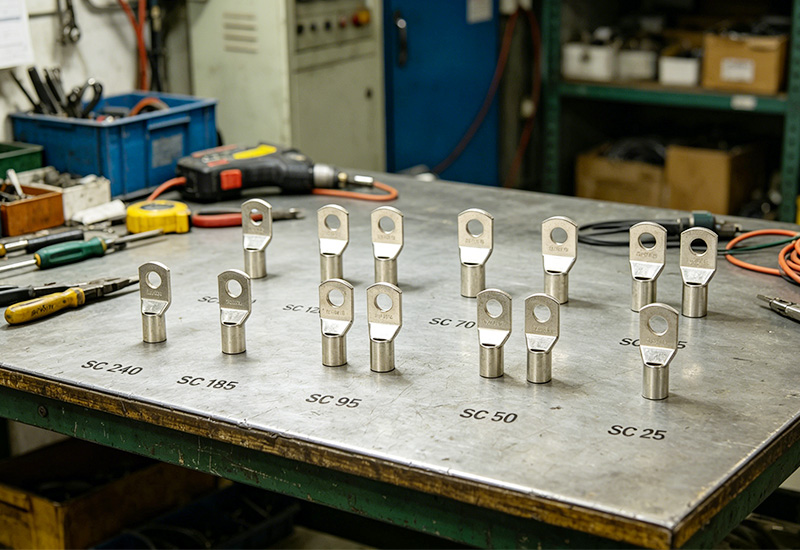
- Often used for copper lugs and small gauge wires
- Westlec manual crimpers provide consistent results when paired with the correct dies
Ratcheting Crimping Tools
Ratcheting crimpers are a step up in both consistency and ease-of-use. These tools use a ratchet mechanism that prevents the jaws from releasing until the crimp is fully compressed.
For instance, when assembling automotive wiring harnesses, a ratcheting crimper ensures that each insulated terminal is compressed perfectly—reducing errors and increasing efficiency.
Key points:
- Ensures uniform crimps every time
- Minimizes human error compared to manual pliers
- Suitable for medium gauge wires and standard terminals
- Ergonomic handles reduce operator fatigue
- Supports high-volume tasks with repeatable results
- Westlec ratcheting crimpers include multiple die options for various terminal sizes
Hydraulic Crimping Tools
For heavy-duty cables and large lugs, manual or ratcheting crimpers simply don’t cut it. Hydraulic crimpers, either hand-pump or battery-powered, generate tremendous compressive force.
Picture a technician installing a 2/0 AWG battery cable on a commercial vehicle—the hydraulic crimper easily compresses the lug without straining the operator.
Key points:
- Ideal for thick cables and heavy-duty lugs
- Reduces physical effort and improves efficiency
- Interchangeable dies or dieless options accommodate various wire sizes
- Suitable for industrial and high-volume applications
- Battery-operated models allow one-handed operation
- Westlec hydraulic crimpers ensure precise, secure crimps for large conductors
Specialty Crimping Tools
Certain applications demand specialized crimpers. Open-barrel crimpers, ferrule crimpers, coaxial crimpers, and modular plug crimpers each serve unique needs.
For example, when working on high-end electronics or RF connectors, the right specialty crimper prevents damage and ensures signal integrity.
Key points:
- Open-barrel crimpers wrap terminals around fine wires
- Ferrule crimpers compress stranded wires for screw terminals
- Coaxial crimpers secure RG6/RG59 connectors for minimal signal loss
- Modular plug crimpers (RJ45) simplify Ethernet cable terminations
- Designed for specific connector types to maximize reliability
- Westlec provides a range of specialty tools tailored to professional needs
Crimp Dies & Profiles (Hex, Indent, Square, Oval, B/F-Crimp)
The die profile determines the shape of the compressed terminal—impacting mechanical strength and electrical conductivity.
Hex crimps, for example, provide uniform compression, ideal for copper lugs in power applications. Indent crimps suit fine-stranded wires or aluminum conductors. Other profiles like square, oval, or B/F-crimp cater to ferrules and open-barrel terminals.
Key points:
- Hex crimps create strong, even compression for copper/aluminum lugs
- Indent crimps lock fine strands together to prevent slip-out
- Square and oval crimps suit multi-pin connectors or insulated terminals
- B/F-crimp profiles secure both wire and insulation for strain relief
- Correct die selection prevents under- or over-compression
- Westlec dies are precision-engineered to match terminals and ensure gas-tight connections
Crimping Tool Types vs Wire Gauge & Application Table
| Tool Type | Wire Gauge Range | Typical Use Case | Advantages | Example Westlec Product | Notes |
|---|---|---|---|---|---|
| Manual Crimper | 24–12 AWG | Small panels, repairs | Lightweight, portable | Westlec Basic Plier Crimper | Requires careful technique |
| Ratcheting Crimper | 22–6 AWG | Auto wiring, standard terminals | Consistent crimps, ergonomic | Westlec Ratchet Crimper Kit | Multi-die compatible |
| Hydraulic Crimper | 4 AWG–2/0 AWG | Battery cables, industrial lugs | High force, minimal effort | Westlec Hydraulic Crimper | Interchangeable dies |
| Open-barrel Crimper | 26–20 AWG | PCB & electronics | Wraps terminals evenly | Westlec Open-Barrel Crimper | Ideal for fine wires |
| Ferrule Crimper | 28–12 AWG | Control panels, screw terminals | Prevents strand slip-out | Westlec Ferrule Crimper | Hex or square profile available |
| Modular Plug Crimper | N/A | Ethernet cables | Precise RJ45 crimps | Westlec RJ45 Crimper | Includes strain relief feature |
How to Choose the Right Crimp Tool for Your Application
Choosing the best crimper depends on three main factors: wire size, terminal type, and application scale.
Consider the following guidance:
- Match the tool type to the wire gauge and connector style
- Always check the die/profile recommended by the connector manufacturer
- High-volume production may benefit from ratcheting or hydraulic tools
- Field maintenance requires versatile, portable crimpers
- Specialty connectors like ferrules or coax require dedicated tools
- Westlec offers comprehensive kits that pair crimpers, dies, and terminals for optimal efficiency
Maintenance, Safety & Best Practices
Even the best crimper will fail without proper care.
- Keep dies clean and free of debris to ensure precise crimps
- Lubricate moving parts and check hydraulic fluid levels if applicable
- Inspect crimp quality regularly using a pull test or microscopic check
- Store tools in protective cases to avoid misalignment or damage
- Use calibrated dies for professional-grade results
- Westlec provides after-sales support and calibration guidance for long-term reliability
FAQ
How do I evaluate a crimping tool’s reliability?
A: Check crimp consistency, tensile pull-out strength, and gas-tightness. Professional tools like Westlec’s are UL-certified.
What’s the difference between manual, ratchet, and hydraulic crimpers?
A: Manual relies on hand pressure, ratchet ensures uniform crimps, and hydraulic handles large wires with minimal effort.
How does the crimp profile affect connection strength?
A: Hex crimps distribute force evenly, indent crimps secure fine strands, and wrong profiles can loosen connections.
Can I use a manual crimper for large battery cables?
A: Not recommended. Hydraulic crimpers are best for high-gauge lugs.
What are the advantages of a ratcheting crimper for production work?
A: Consistency, reduced errors, and ergonomic operation for high-volume tasks.
How often should I calibrate my crimping tool?
A: Regularly, especially if used heavily or for critical electrical installations.
Can I use the same die for copper and aluminum lugs?
A: Hex dies often work for both, but always check manufacturer recommendations.
How do I know if I over-crimped a wire?
A: Wire strands may break, connector deforms excessively, or pull-out tests fail.
What safety precautions should I take while crimping?
A: Wear gloves, ensure proper die selection, and avoid overexertion.
How do hydraulic crimpers improve efficiency?
A: They reduce manual effort and crimp heavy lugs quickly and consistently.
Can I use one crimper for multiple terminals?
A: Only if it has interchangeable dies or adjustable pressure features.
How do I prevent under-crimping?
A: Use ratcheting or hydraulic tools and follow manufacturer specifications.
How can I check crimp quality in the field?
A: Perform a pull test, inspect for uniform compression, and check for wire play.
Why invest in professional-grade crimping tools?
A: Safety, reliability, efficiency, and compliance with industry standards.
Conclusion
Choosing the right crimping tool is critical for secure, durable electrical connections. Manual crimpers are perfect for light-duty jobs, ratcheting crimpers ensure consistent results, and hydraulic crimpers handle heavy-duty cables effortlessly. By understanding die profiles, tool types, and proper techniques, you can improve reliability, reduce errors, and save time. Equip yourself with Westlec’s high-quality crimping tools today and ensure every crimp is safe, strong, and long-lasting. Upgrade your toolkit and crimp with confidence—your connections deserve nothing less.
 EN
EN  PT
PT