


Choosing between crimp terminal manufacturers is a quality decision, not a price decision. Seven factors separate a dependable supplier from a risky one: product type coverage, material and plating specification, traceable certifications, documented process control, tooling compatibility, realistic MOQ and lead time, and engineering support. Score all seven before you negotiate, and the lowest quote usually stops looking like the cheapest option.
A crimp terminal forms a permanent, gas-tight cold weld between a conductor and a connector. Once it is buried inside a control cabinet, an appliance harness or a solar combiner box, nobody re-inspects it. That is exactly why the manufacturer you choose quietly determines your field failure rate, your warranty exposure and your compliance risk.
This guide is written for procurement teams, panel builders and OEM engineers who buy crimp terminals in volume. It sets out the seven factors, the evidence you should demand for each, and a copy-and-use supplier scorecard you can take straight into your next sourcing review.
Key Takeaways
- Seven factors decide the outcome: type coverage, material and plating, certifications, process control, tooling compatibility, MOQ and lead time, engineering support.
- Ask for evidence, not adjectives. “High quality” is marketing. A pull-test report, a crimp-height record and a material certificate are proof.
- Terminal, tooling and wire are one system. A terminal qualified with one die and one wire range is not automatically valid with another.
- Unit price is only part of the real cost. Rework, downtime, returns and failed audits usually cost far more than the cents saved per piece.
- Score suppliers with weights first, so price enters the conversation last rather than first.
Why Your Choice Of Crimp Terminal Manufacturer Matters
A bad crimp rarely fails loudly. It degrades. Contact resistance creeps up, the joint runs warm, thermal cycling loosens it further, and months later a machine trips intermittently or a terminal discolours inside a panel. By then the terminal is one of hundreds in a harness, and the root cause is expensive to prove.
The practical risks of choosing the wrong supplier are consistent across industries:
- Intermittent faults that are hard to trace. An under-compressed crimp passes a visual check and a gentle tug, then fails under vibration.
- Localised heating. Higher contact resistance turns the joint into a small heater, accelerating insulation ageing.
- Compliance exposure. If a terminal cannot be traced to a material certificate or a recognised product standard, your finished assembly carries the risk.
- Rework and recall cost. Re-terminating a harness in the field costs many times more than the terminal itself.
- Tooling lock-in. Switching suppliers mid-project often means re-qualifying dies, crimp heights and pull-test results.
None of these risks show up on a quotation. They show up in production and in the field, which is why supplier evaluation has to happen before the purchase order, not after.
7 Key Factors When Selecting Crimp Terminal Manufacturers
Use the seven factors below as a structured evaluation. For each one, ask the manufacturer for a document, a number or a sample — not a promise.
1. Product Range And Type Coverage
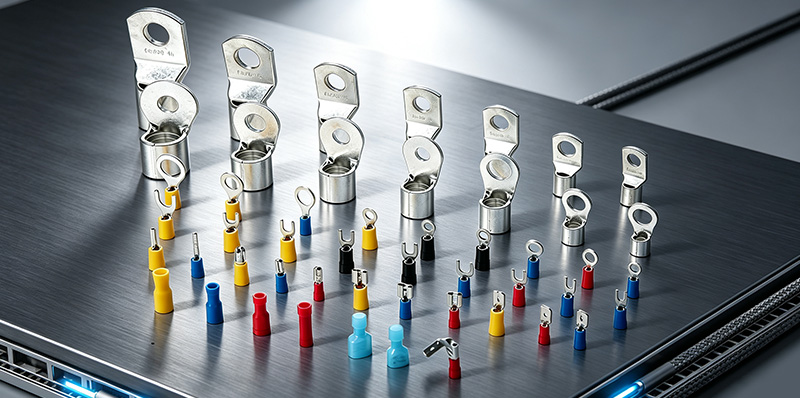
Crimp terminals are not one product. They are a family: ring terminals, fork (spade) terminals, pin terminals, bullet terminals, butt splice terminals, male and female disconnectors, and copper tube terminals for large cable cross-sections. Each of those comes in insulated, non-insulated and heat-shrink waterproof versions, and each insulated version may use vinyl (PVC) or nylon (PA66) sleeves.
Why this matters when comparing manufacturers: breadth usually signals tooling investment. A factory that runs a genuine crimp terminal range across ring, fork, pin, bullet and splice families has already solved the die design, plating and inspection problems that a single-product workshop may never have encountered. It also reduces your supplier count, which simplifies qualification and consolidation of shipments.
Ask specifically: which types are made in-house and which are bought in and resold? Resold lines often mean inconsistent tolerances between batches.
2. Material And Plating Specification
Material is where cheap terminals quietly cut cost, and it is invisible once the part is crimped.
- Base metal. Most insulated terminals use electrolytic tough pitch (ETP) copper, commonly specified as C11000 with copper content of 99.9% or higher, because conductivity and ductility both matter during crimping. Brass is used where spring contact force matters, such as in some disconnector bodies. For large cross-sections, solid copper tube terminals are the standard solution.
- Plating. Tin plating over copper protects against oxidation and keeps the joint stable. Ask the manufacturer to state the plating material, the thickness in microns, and the specification it is tested to — electrodeposited tin coatings are commonly specified to ASTM B545 service classes. A supplier who cannot answer this in writing is guessing.
- Barrel wall thickness. Thinner walls save material but change crimp behaviour and reduce the margin between under- and over-compression.
- Insulation sleeve. Vinyl (PVC) and nylon (PA66) sleeves differ in temperature rating, chemical resistance and flammability rating. Confirm the rating your application needs, particularly inside enclosures that run warm.
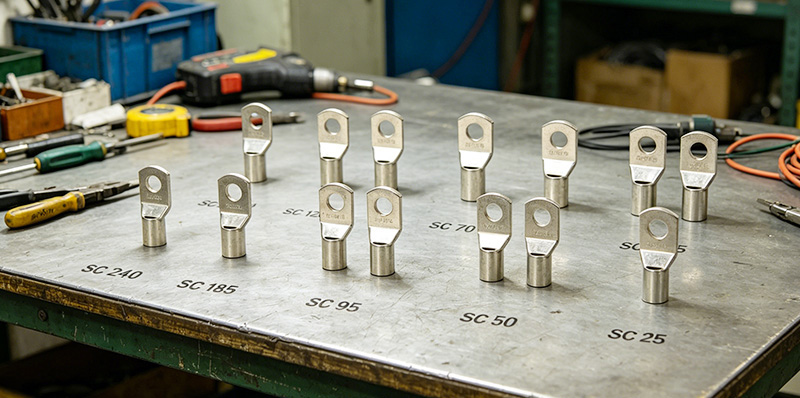
If your project involves large conductors, review the manufacturer’s copper tube terminals separately — the material purity, wall thickness and crimping method differ enough from stamped terminals that they deserve their own qualification.
3. Certifications And Traceable Compliance
A certificate on a website is a claim. A certificate with a number, an issuing body, a scope and a validity date is evidence. Request all four.
- Quality management: ISO 9001 for the factory. IATF 16949 if you supply automotive.
- Product standards: UL 486A-486B for wire connectors and soldering lugs, IEC 60352-2 for crimped solderless connections, and EN/IEC 61238-1 for compression connectors used on power cables. Which one applies depends on your market and conductor size.
- Material compliance: RoHS and REACH declarations for EU and most export markets.
- Flammability: UL 94 rating for the insulating sleeve where the terminal is used inside equipment.
One detail buyers consistently miss: a product certification covers a system, not just a part. The terminal, the crimping tool and the wire gauge range are qualified together. If you crimp a listed terminal with a different die, you are outside the scope of that listing. We cover this in detail in our guide to crimp terminal certifications.
4. Process Control And Test Evidence
This is the factor that most reliably separates a real manufacturer from a trading company. Ask what is measured, how often, and what happens when a measurement drifts.
- Crimp height measurement. Measured at setup and at defined intervals with a blade micrometer. Typical tolerance bands are around ±0.05 mm for smaller terminals and around ±0.10 mm for larger power terminals, depending on the terminal design. Crimp height is the single most useful non-destructive predictor of joint quality.
- Crimp force monitoring. Automated presses with force monitoring catch drift on every stroke rather than at the end of a shift.
- Pull (tensile) testing. Destructive sampling at setup, after tooling or material changes, and at defined intervals. The preferred failure mode is the conductor breaking outside the crimp, not the wire pulling out of the barrel.
- Cross-section (micro-section) analysis. Confirms strand compression, void levels and symmetrical barrel closure — the only way to see inside a finished crimp.
- Environmental testing. Salt spray for plated parts, thermal cycling and humidity exposure for insulated ranges.
Ask for a sample test report with actual values, dates and batch references. A supplier with real process control will send one within a day.
5. Tooling And Crimp Compatibility
A terminal is only as good as the crimp that is put on it. Before you commit, confirm three things in writing: the recommended crimping tool and die, the specified crimp height for each wire size, and the wire range the terminal is qualified for.
Colour coding is a useful shortcut on site. Red sleeves generally cover 22–18 AWG, blue covers 16–14 AWG, and yellow covers 12–10 AWG — but colour conventions vary slightly between manufacturers, so always confirm against the published wire range rather than assuming. Our crimp terminal size chart covers AWG, cross-section and wire compatibility in more detail.
If you run automatic crimping machines, also confirm the terminal is available on strip or in tape-and-reel packaging, because feed geometry affects uptime more than most buyers expect.
6. MOQ, Lead Time And Supply Stability
Commercial terms decide whether the relationship survives your second order.
- MOQ per size, not per order. A low headline MOQ is meaningless if it applies per size and you need twelve sizes.
- Lead time for standard versus custom. Get both, and ask how lead time behaves in peak season.
- Capacity and raw material exposure. Copper price moves. Ask whether quotations are indexed to copper, and for how long a price is held.
- Buffer stock and consignment. For repeat programmes, safety stock held at the factory is often worth more than a small price discount.
- Second source readiness. If a single size is single-sourced and single-tooled, you have a dependency. Ask what happens if that line goes down.
7. Engineering Support, Customization And After-Sales
For OEM and private-label buyers this factor often outweighs price. Confirm the manufacturer can provide: dimensional drawings and samples before order, first article inspection reports, custom barrel lengths or stud sizes, custom plating, printed or embossed markings, retail or bulk packaging, and private-label branding.
Equally important is what happens when something goes wrong. Ask who owns a quality complaint, how fast replacement stock ships, and whether a corrective action report is issued. A supplier that answers these questions clearly before you buy is likely to answer them clearly after.
Shortlisting Crimp Terminal Manufacturers Right Now?
Send WESTLEC your wire sizes, annual volumes and target certifications. Our engineering team will return a factory-direct quotation with samples, crimp-height data and a confirmed lead time — usually within one business day.
Supplier Scorecard: Compare Crimp Terminal Manufacturers Side By Side
Weights are a starting point — adjust them to your application. A solar installer will weight certification and corrosion testing higher; an appliance OEM will weight packaging and dimensional consistency higher. The discipline that matters is scoring before you see the price.
| Factor | What To Request | Weight | Score 1–5 |
|---|---|---|---|
| 1. Type coverage | Full catalogue plus a written list of which lines are made in-house | 15% | |
| 2. Material and plating | Material certificate, copper purity, plating thickness in microns and test standard | 20% | |
| 3. Certifications | Certificate numbers, scope, issuing body, validity dates, RoHS and REACH declarations | 15% | |
| 4. Process control | Crimp-height records, pull-test report with batch references, sample micro-section | 20% | |
| 5. Tooling compatibility | Recommended tool and die, crimp-height specification, qualified wire range | 10% | |
| 6. MOQ and lead time | MOQ per size, standard versus custom lead time, copper price policy, buffer stock | 10% | |
| 7. Engineering support | Drawings, samples, first article report, OEM and private-label options, complaint process | 10% | |
| Total | Weighted result — compare suppliers before discussing price | 100% |
Quick Reference: Wire Size, Sleeve Colour And Pull-Force Benchmarks
Use this table as a sanity check when you review a supplier’s test data. The pull-force figures are reference ranges drawn from the minimum values published in IEC 60352-2 and UL 486A-486B.
| Wire size (AWG) | Cross-section | Sleeve colour | Typical minimum pull force |
|---|---|---|---|
| 22 AWG | 0.34 mm² | Red | 36–51 N |
| 20 AWG | 0.50 mm² | Red | 58–73 N |
| 18 AWG | 0.82 mm² | Red | 85–101 N |
| 16 AWG | 1.5 mm² | Blue | 134–150 N |
| 14 AWG | 2.5 mm² | Blue | 223–230 N |
| 12 AWG | 4 mm² | Yellow | 310–312 N |
| 10 AWG | 6 mm² | Yellow | 356–360 N |
Values are indicative reference ranges for copper conductors. Minimum values differ between standard editions and depend on conductor stranding and terminal design, so always confirm against the terminal datasheet and the standard that applies in your market. The acceptance criterion that matters most is the failure mode: the conductor should break before it pulls out of the barrel.
Most of these sizes are stocked as vinyl-insulated ring terminals, butt splices and disconnectors, which keeps qualification simple when a project spans several wire gauges.
5 Red Flags When Sourcing Crimp Terminals
- No pull-test or crimp-height data. If nothing is measured, nothing is controlled.
- Certificates without numbers, scope or dates. Unverifiable documents usually are.
- Refusal to state base material or plating thickness. This is the most common place where cost is quietly removed.
- A price far below the market with no specification attached. Compare like for like; a thinner barrel and lighter plating are invisible in a photo.
- Samples arrive late, incomplete or without drawings. Sample handling predicts production handling.
Total Cost Of Ownership: Why The Lowest Unit Price Misleads
On a quotation, the difference between two suppliers may be a fraction of a cent per terminal. On a production line, the same decision shows up as crimping tool re-qualification, inconsistent crimp heights, a batch of harnesses that fails pull testing, or an audit finding on missing material traceability. Any one of those costs more than the entire terminal spend on the project.
There is a second, quieter saving in standardisation. Consolidating a panel build onto one family — for example standardising on insulated fork terminals and matching ring types from a single manufacturer — reduces the number of dies you must qualify, the number of part numbers you stock, and the chance of the wrong terminal reaching the wrong station.
The most reliable way to buy crimp terminals is to qualify the process first and negotiate the price second. Suppliers with real process control are usually happy to prove it, because evidence is their advantage.
Get Samples And A Quotation From WESTLEC
WESTLEC is a factory-direct crimp terminal manufacturer supplying distributors, panel builders and OEMs worldwide. ISO 9001 quality management, RoHS and REACH compliant materials, OEM and ODM support, and full documentation from crimp-height records to material certificates.
Frequently Asked Questions
What should I look for when choosing a crimp terminal manufacturer?
Focus on seven things: the range of terminal types made in-house, the base material and plating specification, traceable certifications, documented process control such as crimp-height measurement and pull testing, tooling compatibility with your crimping equipment, realistic MOQ and lead time, and genuine engineering support. Ask each supplier for written evidence for every point rather than general assurances.
How do I verify crimp terminal quality before placing a bulk order?
Order samples from the actual production line, not sample-only stock. Crimp them with your own tooling and your own wire, then measure crimp height against the manufacturer’s specification and run a pull test on a sample. Ask the manufacturer for its own pull-test report and crimp-height records for the same batch. If the numbers do not match, the process is not controlled.
What certifications should a crimp terminal manufacturer provide?
At minimum, ISO 9001 for the factory quality system plus RoHS and REACH declarations for material compliance. Depending on your market and conductor size, also ask for compliance with UL 486A-486B, IEC 60352-2 or EN/IEC 61238-1, and a UL 94 flammability rating for the insulating sleeve. Always request the certificate number, scope, issuing body and validity date.
What is the typical minimum order quantity for crimp terminals?
MOQ varies widely by manufacturer and by terminal size. The important question is whether the MOQ applies per size or per order, because a project that needs twelve sizes can turn a low headline MOQ into a large total commitment. Factory-direct manufacturers can often mix sizes within one shipment or hold buffer stock for repeat programmes, so ask about both.
Can crimp terminal manufacturers provide custom or OEM terminals?
Most established manufacturers offer OEM and ODM support: custom barrel lengths, stud sizes, plating, markings, packaging and private-label branding. What distinguishes a capable partner is documentation — dimensional drawings before tooling, samples for approval, and a first article inspection report before volume production starts.
What is the difference between vinyl-insulated and nylon-insulated crimp terminals?
Vinyl (PVC) sleeves are the general-purpose option and are widely used in control panels and appliance wiring. Nylon (PA66) sleeves generally offer better resistance to higher temperatures, abrasion and some chemicals, and are preferred in automotive and heavy equipment environments. Both must be matched to the correct wire range and crimped with a die that suits the insulation crimp.
Are crimp terminals better than soldering for industrial wiring?
For production wiring, crimping is generally preferred. A correctly made crimp is a gas-tight cold weld that resists vibration better than a soldered joint, does not create a stiff section where strands can fatigue, and is faster and more repeatable to apply. Soldering still has a place in some repair and prototyping work, but a crimped connection is easier to inspect and to standardise.
How long does it take to receive samples and production quantities?
Standard catalogue terminals are usually sampled within days and shipped within the manufacturer’s published standard lead time. Custom or private-label terminals take longer because tooling, drawings and first article approval come first. Ask for both figures separately, and confirm how lead time behaves during peak season before you commit to a project schedule.
Conclusion: Qualify The Process, Then Negotiate The Price
Selecting between crimp terminal manufacturers is not about finding the lowest number on a quotation. It is about finding a supplier whose process you can verify: material you can trace, dimensions you can measure, certifications you can check, and test data that arrives with the shipment.
Run the seven factors as a weighted scorecard, demand the documents listed for each one, and validate the first batch on your own tooling before volume production. Do that, and price becomes the last variable instead of the only one — which is where reliable sourcing decisions are actually made.
About The Author
This guide was prepared by the WESTLEC engineering and quality team. WESTLEC is a factory-direct manufacturer of low-voltage electrical components based in Yueqing, Zhejiang, China. Our product range covers crimp terminals, copper tube terminals, DIN rail terminal blocks, quick connect terminal blocks, waterproof cable glands, busbars and distribution boxes, supplied to distributors, panel builders and OEMs in global markets under an ISO 9001 quality management system.
Last reviewed: September 2026.
Related Resources
- What Certifications Should A Crimp Terminal Manufacturer Provide?
- How Manufacturers Produce High Quality Crimp Fork Terminals
- Female Crimp Connector Size Guide: AWG, Pitch And Wire Compatibility
- Everything About Electrical Crimp Terminals: Types, Uses & Standards
- Copper Tube Terminals: Manufacturing & Crimping Guide
 EN
EN  PT
PT 