

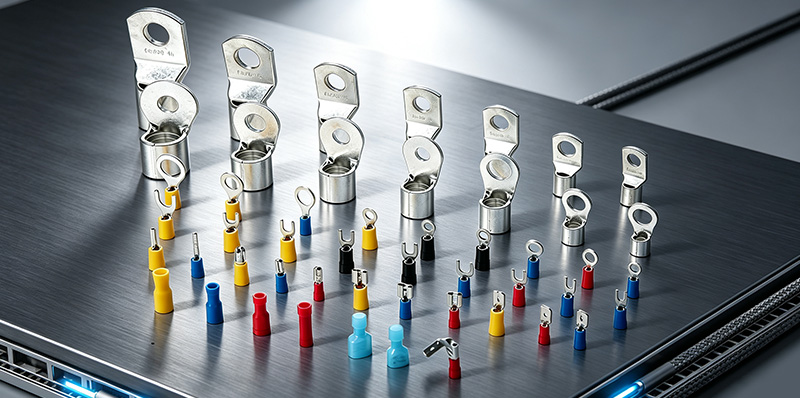
Crimp fork terminals—often called spade terminals—are among the most common electrical connectors used in control panels, industrial machinery, and automotive wiring harnesses. Their open, fork-shaped end lets a technician connect or remove a wire without fully unscrewing the terminal, which speeds up maintenance and cuts downtime. But that convenience is only as good as the way the terminal is made. For B2B buyers, knowing how manufacturers produce high quality crimp fork terminals is the first step to avoidingfield failures, recalls, and supply-chain risk.
This guide walks through the full production workflow—from raw material selection to final crimp inspection—and explains the quality factors that separate a reliable insulated fork terminal from a low-cost imitation.
Selecting Premium Raw Materials
The foundation of any durable fork terminal is the conductor metal. Most terminais de crimpagem are made from high-purity copper for maximum conductivity, with brass as a cost-effective option for lower-current applications. The barrel and fork body must be drawn from consistent-gauge strip so there are no thin spots that could weaken under load.
The insulation sleeve—usually PVC or nylon—is chosen for the target environment: PVC for dry indoor panels, nylon where temperature and abrasion resistance matter more. Reputable manufacturers also specify tin or nickel plating on the copper to slow oxidation, a detail that protects long-term contact reliability.
Precisão Metal Stamping Process
Once the strip is qualified, the fork shape is formed on high-speed progressive stamping dies. Each station cuts, forms, and trims the metal into the familiar U-shaped fork with a crimp barrel. Die maintenance and tonnage control are critical: worn tooling produces burrs, off-angle forks, or inconsistent barrel diameters that later cause poor crimps.
Top production lines run in-process gauging so every batch stays within tolerance. Stable stamping is what lets a buyer trust that a fork crimp terminal ordered in January will match one ordered in December.
Superfície Plating For Better Performance
After stamping, terminals move to plating. Tin plating is the industry standard for solderability and corrosion resistance; nickel or silver may be used for higher-temperature or specialized loads. Uniform plating thickness prevents bare copper exposure and keeps contact resistance low.
A disciplined line validates plating adhesion (tape test) and thickness (XRF sampling) rather than trusting the bath blindly. This step is where many budget suppliers cut corners, and it shows up later as green corrosion at the connection.
Producing Insulated Fork Terminals
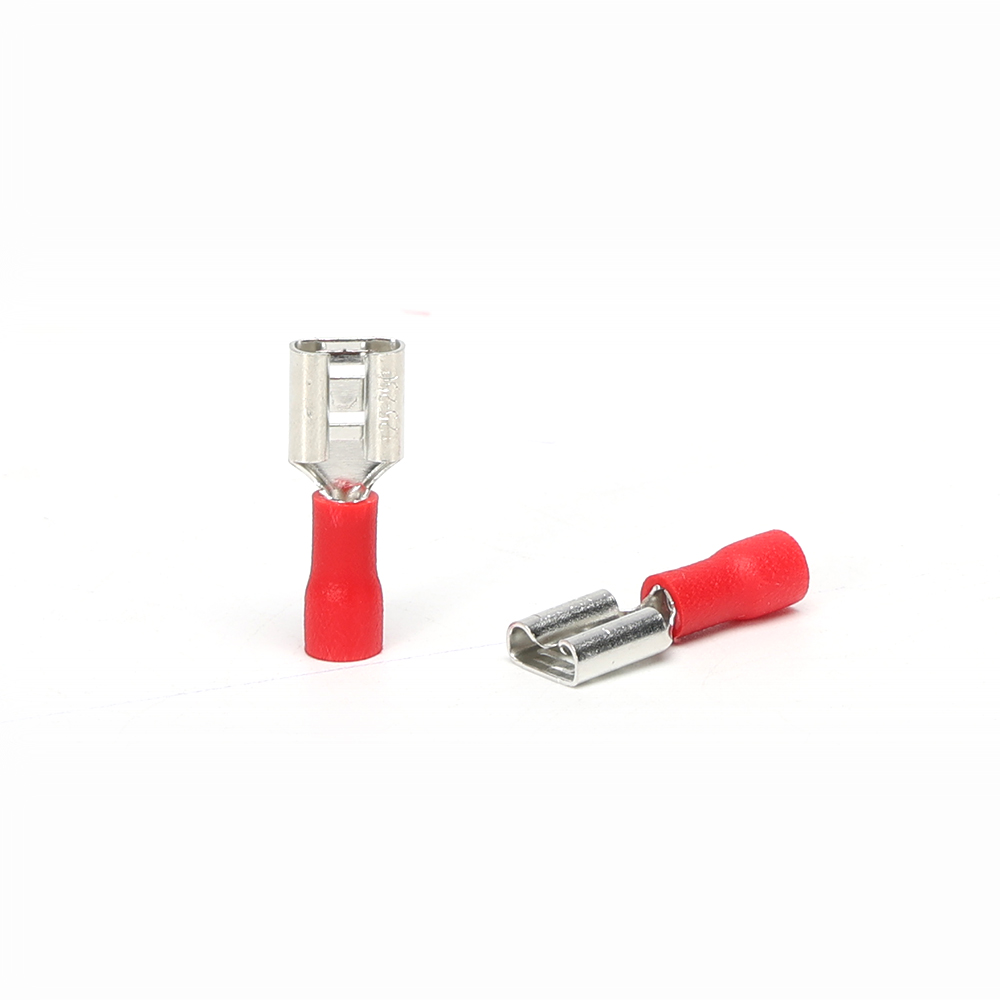
Para insulated fork terminals, a molded PVC or nylon sleeve is pressed and bonded onto the barrel. The sleeve must sit flush, resist cracking during crimping, and keep its color stable over time.
Poor adhesion is a common defect: the insulation slips back and exposes live metal. Makers control this with tight molding pressure and qualified compound lots, then sample-check pull-off force between sleeve and barrel.
 Cor Coding Of Fork Crimp Terminals
Color is not decoration—it is a wire-size signal. Fork crimp terminals follow the same AWG color standard as other insulated crimp terminals, so procurement teams can confirm gauge at a glance:
| Cor | Faixa AWG | Metric (mm²) | Uso típico |
|---|---|---|---|
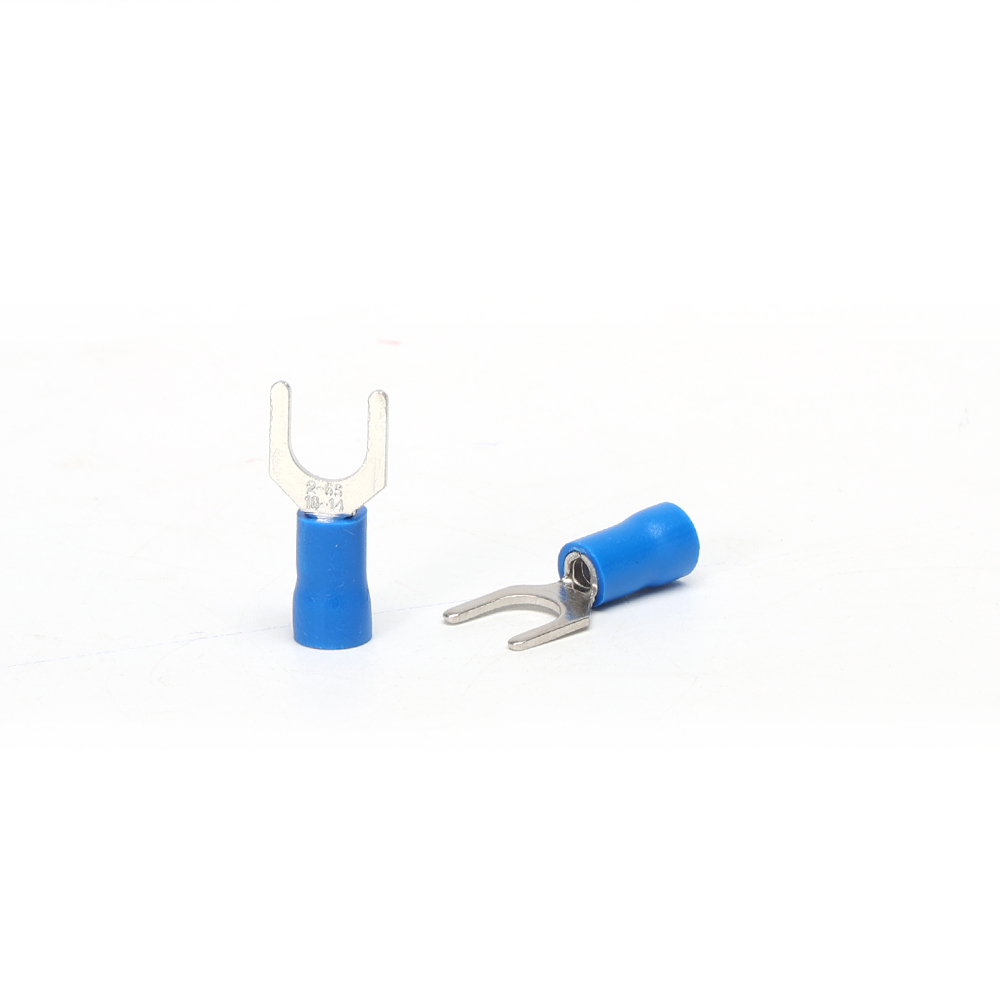
| Vermelho | 22–18 AWG | 0.5–1.0 mm² | Low-voltage, signal, control wiring |
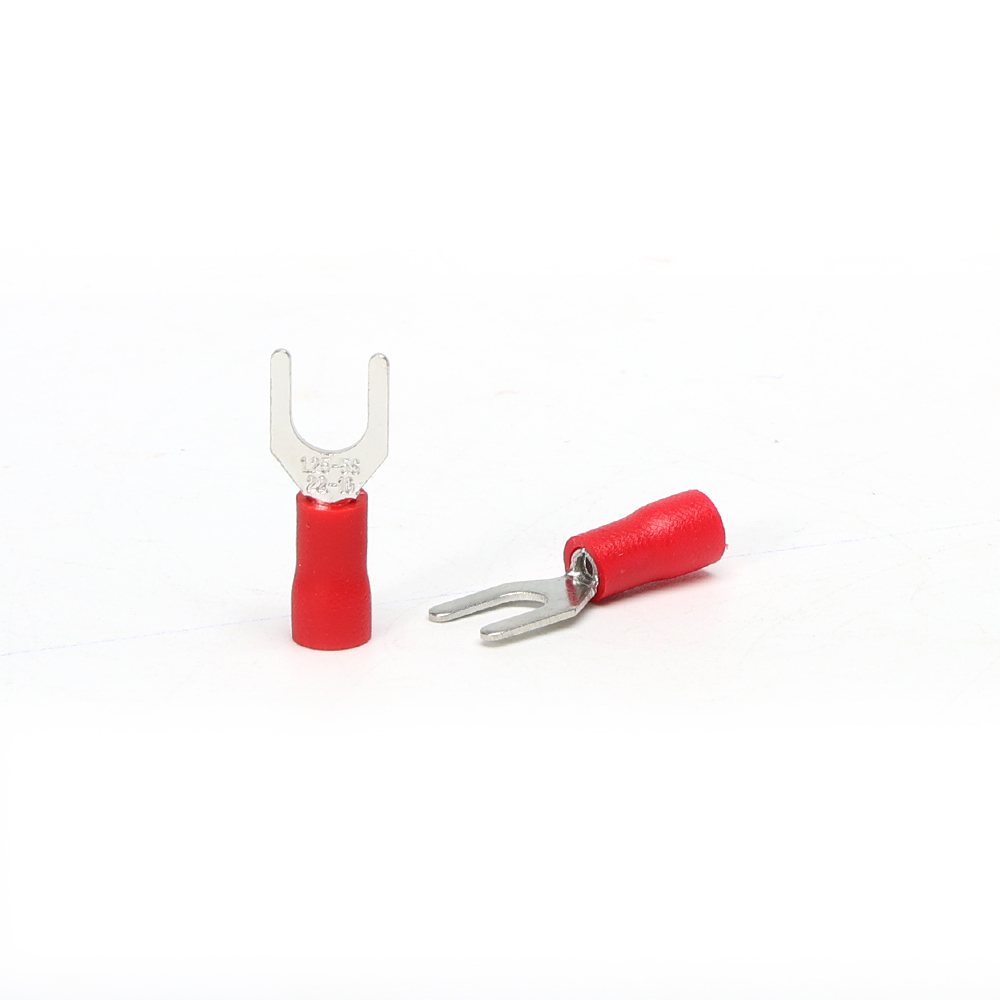
| Azul | 16–14 AWG | 1,5–2,5 mm² | Automotive, general power circuits |
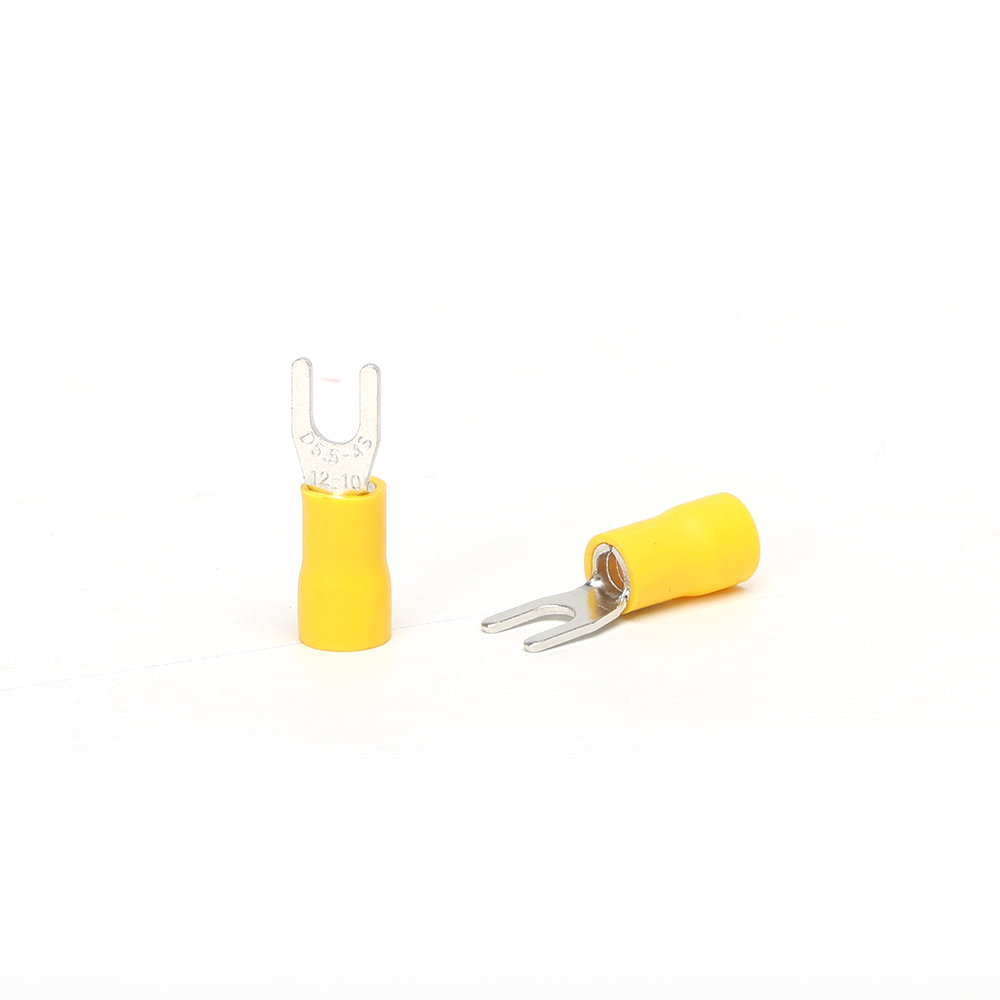
| Amarelo | 12–10 AWG | 4.0–6.0 mm² | Higher-current branch circuits |
So when a buyer specifies yellow fork terminals, blue fork terminals, ou red fork terminals, they are really specifying the wire gauge range the terminal is built to accept. Mixing colors with the wrong wire size is one of the most frequent causes of overheated joints.
Crimpagem Process And Quality Inspection
Even a perfect terminal fails if it is crimped badly. During final assembly, the conductor is inserted to the correct strip length and compressed with a calibrated die matched to the terminal profile. Manufacturers verify the result with a clear checklist:
- Pull test: a set force is applied; the wire must not pull out and the barrel must not open.
- Inspeção visual: no cracks, no split insulation, uniform compression across the barrel.
- Continuity and resistance check on sampled lots to confirm low contact resistance.
- Dimensional check of the fork opening so it fits the target screw or stud.
O fork terminal crimping process is the last line of defense against field failure, which is why auditable test records matter as much as the parts themselves.
Need High-Quality Crimp Fork Terminals for Your Project?
Westlec supplies insulated fork terminals and a full crimp terminal range with ISO 9001 and RoHS compliance, plus OEM/ODM support. Request a factory quote and lead-time estimate today.
Chave Factors That Affect Fork Crimp Terminals Quality
Drawing the steps together, the variables that decide whether a fork terminal performs in the field are:
- Material purity—copper conductivity and consistency of the strip.
- Plating uniformity—even tin or nickel coverage with verified thickness.
- Stamping tolerance—clean forks, correct barrel diameter, no burrs.
- Insulation adhesion—sleeve stays bonded through crimp and service.
- Crimp parameter control—correct die, strip length, and compression.
- Incoming and final inspection—pull test, XRF, continuity on real samples.
- Traceability—lot records so a bad batch can be isolated fast.
For B2B procurement, the safest signal is a supplier that can show these controls rather than just claim them.
Aplicações Of Fork Crimp Terminals
Crimp fork connectors appear wherever quick, serviceable connections matter. Typical uses include:
- Armários de controle elétrico—easy disconnect during panel commissioning and service.
- Automação industrial—machine wiring that needs periodic inspection.
- Automotive and marine harnesses—where tinned copper fights corrosion.
- HVAC and appliances—field-replaceable connections without full disassembly.
- Distribuição de energia—branch connections on bus bars and studs.
In high-vibration environments, buyers often choose ring terminals instead, because a fully enclosed ring cannot slide off a loose screw. Fork terminals trade a little vibration security for much faster maintenance.
Como To Choose A Reliable Fork Terminal Manufacturer
When you evaluate suppliers, consistency matters more than catalog size. A reliable fork crimp terminals manufacturer should demonstrate:
- Certificações—ISO 9001 and RoHS as a baseline; UL or IEC reports for target markets.
- In-house control of stamping and plating, not just trading stock.
- Documented QC—pull test, XRF plating check, and continuity on samples.
- Capacity and lead time that fit your volume and seasonality.
- OEM/ODM support for custom sizes, sleeves, or packaging.
- Traceability so any issue can be traced to a lot and fixed.
Nosso crimp connector selection guide covers specifications in more depth, and our crimp terminal certifications article explains which documents B2B buyers should request before signing.
Perguntas frequentes
Are Fork Crimp Terminals Reliable?
Yes—when made from quality copper with verified plating and a correct crimp. Their open fork design is slightly less vibration-proof than a ring terminal, but for serviceable connections they are dependable across control panels, automotive, and industrial use.
What Materials Are Used For Fork Terminals?
The conductor is usually high-purity copper or brass; the surface is commonly tin-plated for corrosion resistance. The insulation sleeve is typically PVC or nylon, selected by environment.
Which Wire Sizes Use Yellow Fork Terminals?
Yellow fork terminals are built for 12–10 AWG wire (about 4.0–6.0 mm²), the higher-current end of the standard insulated terminal color range.
What Do Red Blue And Yellow Fork Terminals Mean?
They mark wire gauge, not function: red = 22–18 AWG, blue = 16–14 AWG, yellow = 12–10 AWG. The color lets installers confirm the terminal matches the wire at a glance.
How Do Manufacturers Test Crimp Fork Terminal Quality?
They use pull tests for mechanical strength, visual checks for cracks or split insulation, continuity/resistance tests for electrical performance, and plating or dimensional checks on sampled lots.
What Is The Difference Between Insulated And Non-Insulated Terminals?
Insulated terminals have a PVC or nylon sleeve that protects against touch and abrasion; non-insulated terminals are bare metal, smaller and cheaper, and need separate sleeving or a confined space for safety.
Conclusão
High quality crimp fork terminals are the result of disciplined material choice, precise stamping, controlled plating, bonded insulation, correct color coding, and verified crimping. For B2B buyers, the winning move is to partner with a manufacturer that can prove each step—not just quote the lowest price.
Talk To Westlec About Your Fork Terminal Requirements
Share your wire sizes, volumes, and certification needs, and we will return a tailored quote with samples and lead time. Factory-direct pricing, global shipping.
This article is written by the Westlec technical team, a factory-direct manufacturer of low-voltage electrical accessories including crimp terminals, terminal blocks, busbars, and cable glands.
 PT
PT  EN
EN 