


If you are new to electrical panel building, control cabinets, or industrial wiring, the screw connection terminal block is one of the first components you will meet. It is the quiet workhorse that turns a tangle of cables into an organised, safe, and serviceable connection system. This beginner’s guide explains what a screw terminal block is, how it works, what its parts do, the main types available, how to wire one correctly, and how to choose the right model for your project.
This guide is written for panel builders, procurement engineers, and maintenance technicians who need a clear, standards-based explanation rather than marketing claims. Everything below is grounded in IEC 60947-7-1 and common installation practice, so you can apply it directly to real B2B projects.
By the end of this article you will be able to read a terminal block datasheet with confidence, wire a screw clamp terminal without damaging the conductor, and understand why screw connection technology remains the default choice for so many B2B industrial applications.
What Is a Screw Connection Terminal Block?
A screw connection terminal block is a reusable, insulated electrical connector that joins one or more conductors together using a screw-operated clamp. Most models snap onto a standard DIN rail (TS35 per IEC 60715) inside a panel or enclosure, which makes them easy to mount, rearrange, and maintain without drilling or soldering.
Unlike a permanent soldered joint, a screw terminal block lets you connect and disconnect wires many times. The screw does not touch the live conductor directly in well-designed blocks; instead it drives a clamping element that presses the stripped wire against a current-carrying metal bar. This creates a gas-tight, low-resistance contact that can survive vibration, thermal cycling, and years of service.
Screw connection terminal blocks are defined by the international product standard IEC 60947-7-1 (low-voltage switchgear and controlgear – terminal blocks for copper conductors). For the North American market the equivalent is UL 1059 together with CSA C22.2 No. 158. Because IEC and UL ratings are not interchangeable, always read both columns on the datasheet when you export.
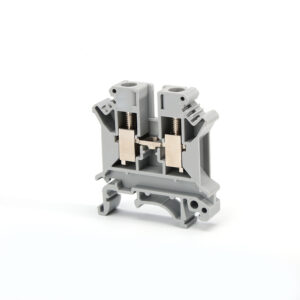
In practice, a screw connection terminal block is the bridge between the fixed wiring of a panel and the flexible cables of field devices. Because the connection is mechanical rather than chemical, it can be opened for testing, modified during commissioning, and repaired in the field without specialised equipment.
Key Parts of a Screw Terminal Block
Understanding the anatomy helps you wire safely and select the right part. The table below shows the main components you will find inside a typical screw clamp terminal block.
| Part | What It Does |
|---|---|
| Insulating housing | Usually moulded PA66 with UL94 V-0 flame rating; isolates live parts and provides finger safety (IP20 touch protection). |
| Current bar | The copper or copper-alloy conductor that carries current between the wire entry and the adjacent block. |
| Clamping screw | The user-tightened screw that converts rotational force into clamping pressure on the conductor. |
| Clamping element / yoke | A washer, cage, or wedge that the screw pushes against the wire so the conductor is not twisted or scored. |
| Wire entry opening | The front or side port where the stripped conductor is inserted to the depth stop. |
| DIN rail foot | The snap-fit base that locks the block onto a TS35/7.5 or TS35/15 symmetrical rail. |
How Does a Screw Connection Terminal Block Work?
The working principle is simple but engineered carefully. When you tighten the clamping screw, it drives a metal clamping element that presses the stripped conductor firmly against the current bar. The pressure is high enough to break through surface oxidation and squeeze out air, producing a gas-tight, low-resistance connection that will not loosen under normal thermal expansion.
There are two common internal designs you should know:
● Screw-direct clamp: the screw tip presses the wire directly. It is compact but can damage fine-stranded conductors if over-tightened.
● Screw-actuated (yoke) clamp: the screw moves a separate clamping yoke or cage that grips the wire. The conductor is never twisted by the screwdriver, which protects stranded wires and gives a more repeatable torque.
The screw-actuated design is the one most industrial brands standardise on, because it tolerates solid and stranded conductors equally and reduces installation error. Whichever design you use, the goal is the same: a stable metal-to-metal contact with a defined tightening torque.
The quality of the joint depends on consistent clamping force. A correctly torqued screw clamp typically shows a contact resistance in the low milliohm range – close to the resistance of the same length of bare conductor – so it adds almost no heat at rated current. If the screw is left loose, resistance climbs, the joint warms, and thermal cycling can loosen it further, which is why a calibrated torque tool is recommended during assembly.
Types of Screw Connection Terminal Blocks
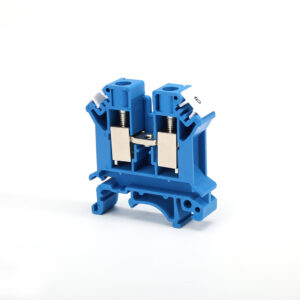
Screw clamp technology is available in many form factors. The list below covers the versions you will encounter most often in control panels and distribution boards.
● Feed-through (single-level): the standard block that simply passes a connection from one side to the other.
● Double-level / multi-level: two isolated connection levels in one body, saving rail space – a good example is the MBKKB 2.5 feed-through screw terminal.
● Grounding / PE terminal: a green-yellow block that bonds the DIN rail and enclosure to earth, often with a metal foot for direct rail contact.
● Fused terminal: integrates a fuse holder so a branch can be protected and replaced without rewiring.
● Disconnect / test terminal: includes a knife switch or plug for safe isolation and measurement.
● Sensor / actuator terminal: built for PLC I/O wiring with centre labelling and compact pitch.
Most of these variants share the same screw clamp core and differ only in the internal current path or accessory. That standardisation is a real advantage for panel builders: once your team knows how to wire one screw terminal, the skill transfers directly to fused, disconnect, and multi-level versions from the same range.
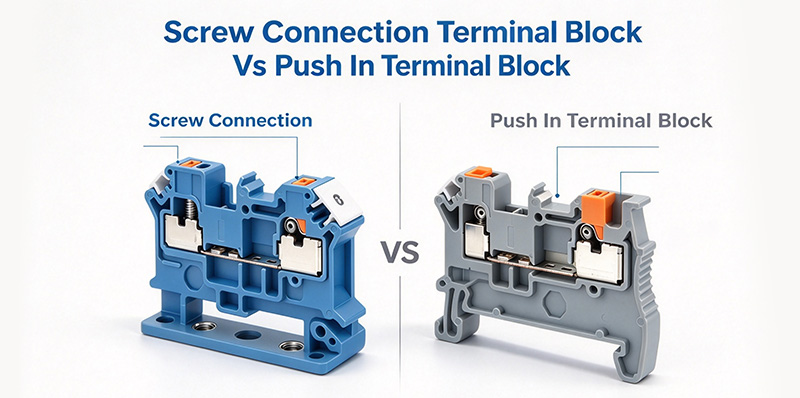
Screw vs Spring-Cage vs Push-In: Which Connection Type?
Screw clamp is only one of three dominant DIN-rail connection technologies. The comparison table below helps you see where each fits, so you can specify the right family for the job.
| Feature | Screw Connection | Spring-Cage | Push-In |
|---|---|---|---|
| Wiring speed | Medium (needs screwdriver) | Medium | Fast (tool-free) |
| Tool required | Screwdriver | Screwdriver / lever | None (lever optional) |
| Vibration resistance | Good with correct torque | Very good | Very good |
| Reusability | Excellent | Good | Good |
| Best for | General panels, high current, serviceable builds | Vibration-heavy machinery | High-volume, repetitive wiring |
Screw connection remains popular because it is forgiving, reusable, and easy to inspect – qualities that matter when a panel must be serviced years after installation.
For most general-purpose B2B panels, specifying screw connection as the default and reserving spring or push-in for high-volume or high-vibration branches gives the best balance of cost, serviceability, and reliability.
How to Wire a Screw Connection Terminal Block (Step by Step)
Correct wiring is the difference between a reliable panel and a call-back. Follow these steps for every screw clamp terminal.
● Strip 10–12 mm of insulation from the conductor end, taking care not to nick the strands.
● Loosen the clamping screw until the wire entry is fully open.
● Insert the stripped conductor to the depth stop so no bare wire is exposed outside the housing.
● Tighten the screw to the torque specified on the datasheet using a calibrated screwdriver.
● Give the wire a gentle pull test to confirm it is clamped, not just resting in the port.
● Apply a clear terminal label so the connection can be traced during maintenance.
Not Sure Which Screw Terminal Block Your Panel Needs?
Our engineering team can review your wiring diagram and recommend rated, standards-compliant screw connection terminal blocks for your exact current and conductor sizes.
Screw Clamp Torque & Conductor Size Reference
The table below is a reference guide only. Exact rated current and tightening torque depend on the specific model, conductor stranding, and the standard edition quoted on the datasheet. Always confirm against the manufacturer’s published figures before commissioning.
| Conductor (mm²) | Typical IEC Rating (A) | Recommended Torque (N·m) | Westlec Example |
|---|---|---|---|
| 0.2–2.5 | up to 24 | 0.5–0.8 | MBKKB 2.5 |
| 2.5–6 | up to 41 | 0.8–1.2 | VK 6N |
| 6–10 | up to 57 | 1.2–1.5 | VSLKG 10N |
| 16–35 | up to 125 | 2.0–2.5 | VSLKG 35 |
| 35–50 | up to 150 | 2.5–3.0 | VSLKG 50 |
Where Are Screw Connection Terminal Blocks Used?
Because they are robust and easy to service, screw terminal blocks appear wherever electrical connections must be safe and inspectable. Common applications include:
● Control panels and PLC cabinets in factories and process plants.
● Power distribution boards and switchgear up to the rated voltage.
● HVAC, building automation, and lighting control systems.
● Renewable energy combiner boxes and battery energy storage.
● Railway, transport, and machinery exposed to shock and vibration.
For higher-current distribution branches, a power-rated block such as the VSLKG 50 high-current screw terminal block carries up to 150 A in a compact DIN-rail footprint, which is why panel builders trust screw clamp technology for the heaviest loads.
What unites these uses is the need for a connection that a technician can open and close with a standard screwdriver. In service-heavy environments – factories, utilities, and transport – that serviceability often outweighs the small speed gain of tool-free push-in connectors, which is why screw technology still dominates the installed base worldwide.
Grounding and Safety Considerations
Protective earth (PE) connections deserve special attention. A dedicated PE terminal – identified by green-yellow marking and a metal rail foot – bonds the enclosure and rail to earth so fault current has a safe path. These blocks follow IEC 60947-7-2 and must never be used for neutral or phase conductors.
When specifying grounding parts, consider the VKK 3 protective earth screw terminal, which provides a secure, low-impedance earth bond on the DIN rail. Keep these safety rules in mind for every installation:
● Tighten PE terminals to the specified torque; a loose earth is a hidden hazard.
● Use IP20 touch-proof designs so live parts are shielded from fingers.
● Respect the rated voltage (e.g. 800 V IEC / 600 V UL) and pollution degree.
● Separate SELV/PELV circuits from mains with adequate creepage and clearance per IEC 60664-1.
It is also good practice to torque and visually verify PE connections during commissioning and to include them in periodic inspection, because an unnoticed open earth is one of the most common hidden faults in ageing panels.
How to Choose the Right Screw Connection Terminal Block
Use the checklist below when specifying terminal blocks for a new panel or a replacement program.
● Confirm the rated voltage and current exceed your worst-case load with margin.
● Match the conductor size range (solid and stranded) to the clamp.
● Decide the number of levels and whether you need fuse, disconnect, or PE functions.
● Verify the mounting rail is TS35/7.5 or TS35/15 per IEC 60715.
● Check compliance with IEC 60947-7-1 (and UL 1059 / CSA for North America).
● Review the environment: temperature range, humidity, and enclosure rating.
● Choose a supplier with documented quality control and ISO 9001 certification.
A simple way to avoid mistakes is to standardise on one manufacturer’s screw range across a project. Matching footprints, marking, and accessories reduces part numbers, simplifies spares, and makes cross-referencing the datasheet faster during audits and maintenance.
Need Datasheets Or A Volume Quote?
Westlec supplies screw connection terminal blocks direct from our Yueqing, Zhejiang factory with full specifications, certifications, and competitive B2B pricing. Send us your BOM and we will respond with a tailored quote.
Frequently Asked Questions
Are screw terminal blocks safe to use?
Yes. When wired to the correct torque and rated within their voltage and current limits, screw connection terminal blocks provide a stable, gas-tight connection that meets IEC 60947-7-1 and offers IP20 finger safety through insulated housings.
What is the difference between a screw and a spring terminal block?
A screw terminal uses a clamping screw to press the conductor, while a spring terminal uses a spring-cage or push-in spring. Screw types are more reusable and easier to inspect; spring types wire faster and resist vibration very well.
Can I use stranded wire with screw terminals?
Yes. A screw-actuated (yoke) clamp is designed for both solid and stranded conductors. For fine-stranded wire, use a ferruled end or a yoke-style clamp and tighten to the specified torque to avoid strand damage.
What torque should I use on a screw terminal block?
Use the torque printed on the datasheet, typically 0.5–0.8 N·m for 2.5 mm² blocks and higher for power terminals. Under- or over-tightening both raise contact resistance and heat, so a calibrated screwdriver matters.
What does DIN rail mean in terminal blocks?
DIN rail is the standard metal mounting rail (TS35 per IEC 60715) inside panels. Terminal blocks snap onto it, which speeds assembly and lets you reconfigure wiring without drilling the enclosure.
Are screw connection terminal blocks reusable?
They are highly reusable. You can loosen, re-terminate, and retighten a screw clamp many times, which is why they remain the preferred choice for panels that need periodic maintenance or modification.
Which standards apply to screw terminal blocks?
The key standards are IEC 60947-7-1 (general), IEC 60947-7-2 (protective earth), IEC 60664-1 (insulation coordination), and UL 1059 / CSA C22.2 No. 158 for North America. Always check both IEC and UL columns when exporting.
How many wires can one screw terminal take?
Most single-level feed-through blocks take one conductor per side, though twin-level and multi-conductor variants accept more. Exceeding the rated number of conductors or mixing sizes beyond the clamp range risks a loose, overheated joint.
About The Author
Written by the WESTLEC Engineering Team
WESTLEC is a low-voltage electrical accessory manufacturer based in Yueqing, Zhejiang, China, producing DIN rail terminal blocks (screw, spring-cage, and push-in), crimp terminals, cable glands, busbars, and wiring accessories for industrial automation and power distribution worldwide. Our products are manufactured under an ISO 9001 quality management system and supported by in-house testing and documentation.
Last reviewed: October 2026.
Related Resources
● Westlec Terminal Block Types: Complete Guide for Industrial Applications
● How to Choose DIN Rail Screw vs Spring-Cage vs Push-In Terminal Blocks
● Screw Connection Terminal Block vs Push-In Terminal Block: Which Is Better?
● DIN Rail Terminal Block Manufacturer Guide: China Supplier Selection
● Top 5 Critical Signs of DIN Rail Screw Terminal Block Failure You Can’t Ignore


 EN
 PT
