

In modern electrical systems, reliable cable terminations are just as important as the cables themselves. Whether you are sourcing components for switchgear, power distribution panels, renewable energy systems, or industrial machinery, choosing the right Copper Tube Terminal can directly impact system safety, conductivity, and long-term reliability.
As a buyer, you may focus on pricing and specifications, but understanding how Copper Tube Terminal Lugs are manufactured and properly crimped can help you avoid costly failures and maintenance issues later. In this guide, you’ll learn how copper tube terminals are produced, which crimping tools are suitable for different applications, and how to evaluate crimping quality before installation.
Copper Tube Terminals: Manufacturing & Crimping Guide
How Copper Tube Terminals Are Manufactured
The performance of a Copper Lug Connector begins long before installation. Manufacturing quality determines conductivity, mechanical strength, corrosion resistance, and service life.
Professional manufacturers follow a series of controlled production processes to ensure every terminal meets industry requirements.
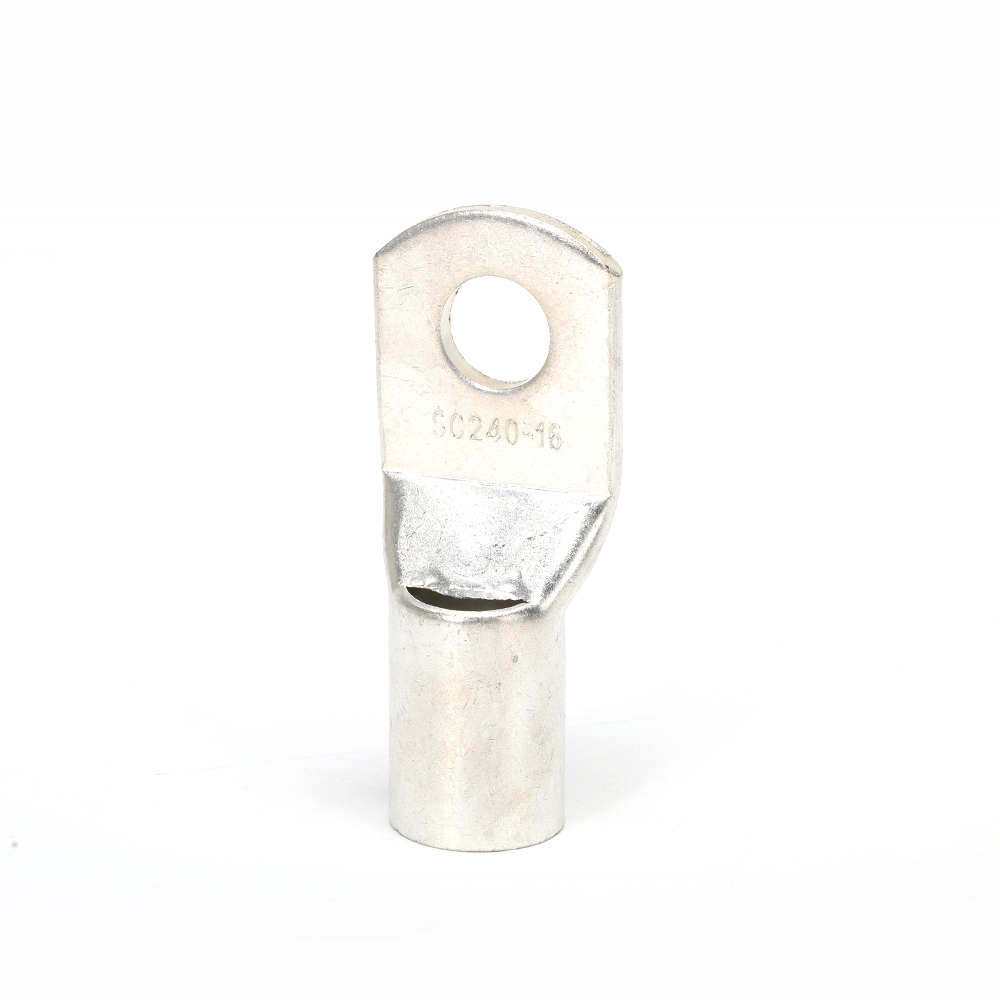
Copper Tube Selection
Everything starts with raw materials.
High-quality Copper Tube Terminal Lugs are typically manufactured from seamless electrolytic copper tubes with a purity level exceeding 99.9%. Pure copper offers excellent electrical conductivity while maintaining the mechanical strength needed for heavy-duty applications.
A reputable manufacturer will carefully inspect incoming copper materials to verify:
● Copper purity
● Wall thickness consistency
● Surface quality
● Dimensional accuracy
● Conductivity standards
Low-grade copper may appear similar externally, but often results in increased electrical resistance and reduced lifespan.
Cutting And Forming
After material verification, copper tubes are cut into precise lengths according to product specifications.
Advanced CNC cutting equipment helps ensure:
● Uniform barrel length
● Smooth cutting edges
● Consistent dimensions
● Minimal material waste
The terminal palm is then formed through stamping and pressing operations.
This stage determines the final shape of the terminal and directly affects installation compatibility.
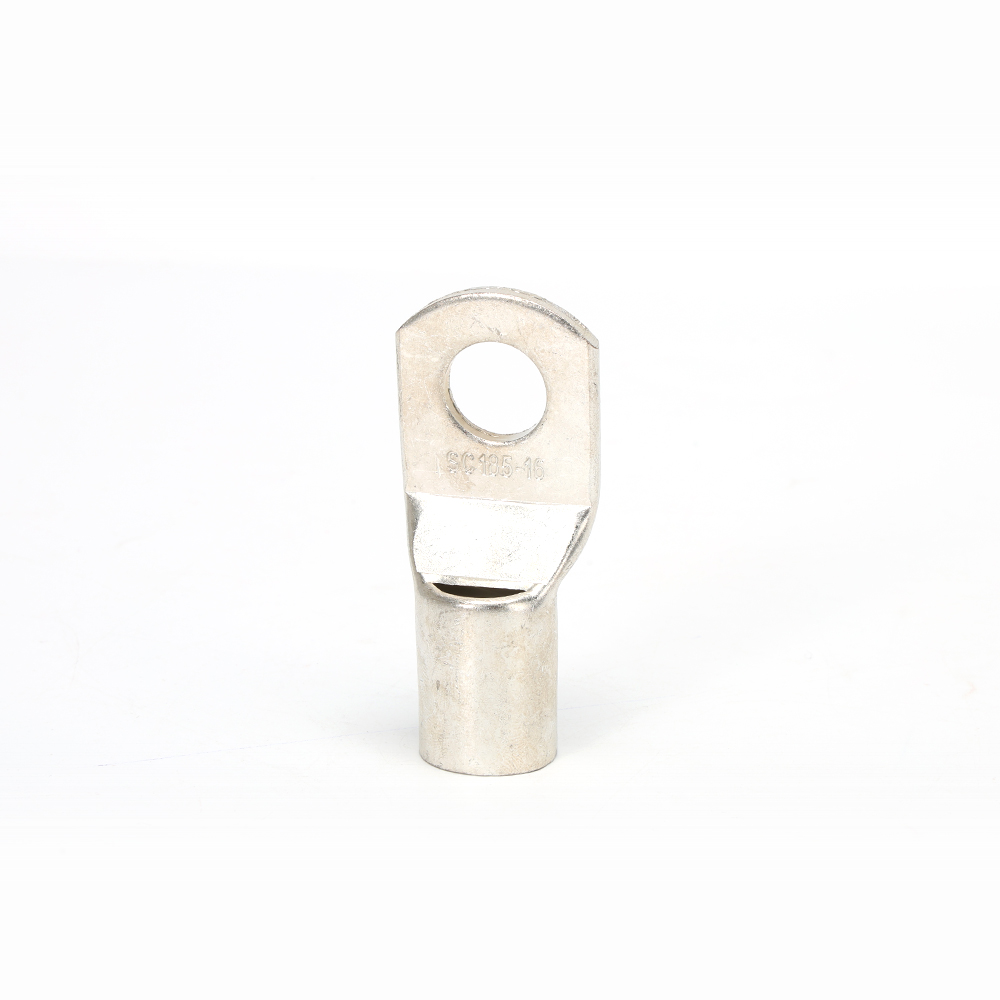
Punching And Hole Making
The mounting hole is one of the most critical features of a terminal.
Precision punching machines create stud holes designed for common bolt sizes such as:
● M6
● M8
● M10
● M12
● M16
Accurate hole dimensions ensure secure fastening while preventing unnecessary movement during operation.
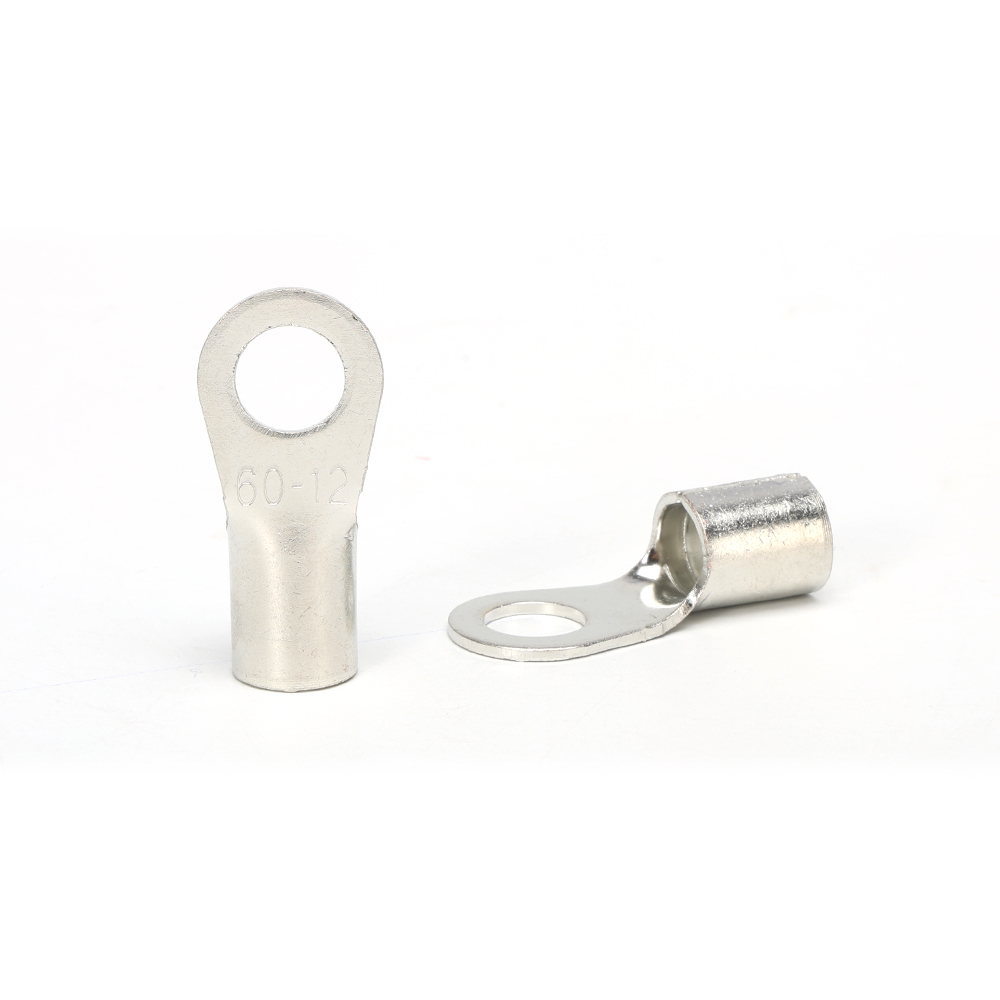
Many industrial users prefer Ring Type Cable Lug designs because the closed-ring structure provides superior vibration resistance compared to fork-type terminals.
Annealing Process
Copper naturally hardens during forming operations.
To restore flexibility and improve crimping performance, manufacturers perform annealing.
During annealing, terminals are heated under controlled conditions and then cooled gradually.
Benefits include:
● Improved ductility
● Better crimping performance
● Reduced cracking risk
● Increased mechanical strength
● Enhanced conductor compression
Without proper annealing, terminals may become brittle and fail during installation.
Surface Treatment
Before plating, terminals undergo thorough cleaning procedures.
The surface must be free from:
● Oxidation
● Oil contamination
● Metal particles
● Production residues
Surface preparation ensures proper coating adhesion and improves corrosion protection.
Tin Plating
Tin plating is one of the most important steps in manufacturing modern Copper Tube Terminal products.
The tin layer provides several advantages:
● Corrosion resistance
● Oxidation protection
● Improved appearance
● Longer service life
● Better environmental durability
For outdoor installations, renewable energy projects, and coastal environments, tin-plated terminals are generally preferred over bare copper alternatives.
Quality Inspection
Professional manufacturers conduct multiple quality inspections throughout production.
Common inspection items include:
| Inspection Item | Purpose | Importance |
|---|---|---|
| Dimensional Check | Verify specifications | Installation accuracy |
| Hole Diameter Test | Confirm bolt compatibility | Secure connection |
| Plating Inspection | Check coating quality | Corrosion resistance |
| Conductivity Test | Verify electrical performance | Safety |
| Pull-Out Test | Evaluate mechanical strength | Reliability |
| Visual Inspection | Detect defects | Quality assurance |
At Westlec, strict quality control procedures help ensure every terminal performs consistently under demanding electrical conditions.
Manufacturing Process Flow
The manufacturing workflow of a high-quality Copper Tube Terminal typically follows the sequence below:
Raw Copper Tube
↓
Material Inspection
↓
Cutting
↓
Forming
↓
Hole Punching
↓
Annealing
↓
Surface Cleaning
↓
Tin Plating
↓
Quality Inspection
↓
Packaging
↓
Shipment
Each stage contributes to the final performance of the terminal. Skipping or poorly controlling any step can significantly affect product quality.
Why Manufacturing Quality Matters
Many buyers compare suppliers primarily based on price.
However, experienced engineers often evaluate manufacturing capability before considering cost.
A well-manufactured Copper Lug Connector delivers advantages that extend far beyond initial purchase savings.
Lower Electrical Resistance
Higher copper purity and accurate compression design reduce resistance.
Lower resistance means:
● Less energy loss
● Reduced heat generation
● Improved efficiency
● Enhanced safety
Greater Mechanical Reliability
Industrial environments often expose cable connections to:
● Vibration
● Thermal cycling
● Mechanical stress
● Outdoor weather conditions
Properly manufactured terminals maintain secure connections under these challenging conditions.
Improved Corrosion Protection
In renewable energy projects, substations, and marine applications, corrosion can significantly shorten component lifespan.
High-quality tin plating protects the terminal surface and helps maintain conductivity over many years.
Longer Service Life
A buyer once replaced low-cost cable lugs across a solar installation after only three years due to severe corrosion.
The replacement terminals, sourced from a certified manufacturer, remained operational for more than a decade with minimal maintenance.
While the initial investment was slightly higher, the overall lifecycle cost was substantially lower.
This is why manufacturing quality should never be overlooked.
Types Of Copper Tube Terminal Crimping Tools
Even the best terminal can fail if improper crimping tools are used.
Different applications require different crimping solutions.
Manual Crimping Tools
Manual crimpers are commonly used for:
● Small cable sizes
● Field installations
● Maintenance work
● Low-volume applications
Advantages include:
● Portable design
● Low investment cost
● Easy operation
● Suitable for light-duty work
However, operator consistency plays a significant role in crimp quality.
Hydraulic Crimping Tools
Hydraulic crimpers are among the most widely used tools for industrial applications.
They provide:
● Higher compression force
● Consistent crimp quality
● Reduced operator effort
● Improved productivity
Hydraulic tools are suitable for medium and large cable sizes commonly found in power distribution systems.
Battery-Powered Crimping Tools
Battery-operated crimpers have become increasingly popular.
They combine portability with automated force control.
Benefits include:
● Faster installation
● Consistent crimp force
● Improved efficiency
● Reduced labor fatigue
These tools are particularly useful for field service teams and utility contractors.
Pneumatic Crimping Machines
For high-volume production environments, pneumatic or fully automatic crimping machines are often preferred.
They offer:
● High production speed
● Repeatable results
● Reduced labor requirements
● Excellent consistency
Manufacturers producing large quantities of cable assemblies frequently rely on automated equipment.
Copper Tube Terminal Crimping Procedure
Proper crimping is essential for achieving a reliable electrical connection.
Even premium-quality terminals can fail if crimping procedures are not followed correctly.
Step 1 Cable Preparation
Remove the insulation carefully without damaging the conductor strands.
The exposed conductor should be:
● Clean
● Straight
● Oxidation-free
Any damaged strands should be removed before installation.
Step 2 Select Correct Die
The crimping die must match both:
● Terminal size
● Cable cross-sectional area
Using an incorrect die can result in weak or over-compressed connections.
Step 3 Insert Conductor
Insert the conductor fully into the barrel.
You should verify that all strands are inside the terminal and evenly positioned.
Step 4 Perform Crimping
Apply compression according to manufacturer recommendations.
Multiple crimps may be required for larger terminals.
The completed crimp should show uniform compression marks without cracks or deformation.
Step 5 Visual Inspection
Inspect the completed crimp carefully.
Check for:
● Barrel cracks
● Incomplete compression
● Exposed strands
● Surface damage
Any visible defect should be corrected immediately.
Step 6 Electrical Testing
Professional installations often include electrical verification.
Common tests include:
● Continuity testing
● Resistance measurement
● Pull-out testing
● Thermal inspection
These tests help confirm long-term reliability.
How To Judge Crimping Quality
After crimping, quality evaluation becomes critical.
A properly crimped terminal should provide both mechanical retention and electrical conductivity.
Characteristics Of A Good Crimp
A good crimp typically exhibits:
● Uniform compression marks
● No visible cracks
● Secure conductor retention
● Low electrical resistance
● Smooth terminal appearance
The conductor should not move when moderate pulling force is applied.
Signs Of Poor Crimping
Poor crimping often shows warning signs such as:
● Loose conductor strands
● Barrel cracking
● Excessive deformation
● Uneven compression
● High resistance readings
These defects can lead to overheating, voltage drops, and premature connection failure.
Practical Recommendation
Many experienced installers perform a visual inspection and pull test immediately after crimping.
While simple, these checks can quickly identify issues before the terminal enters service.
For critical applications such as substations, switchgear, and renewable energy systems, additional electrical testing is strongly recommended to ensure connection integrity.
Key Benefits Of Copper Tube Terminals
When selecting electrical termination components, performance and reliability are often more important than the initial purchase price. High-quality Copper Tube Terminal Lugs have become the preferred choice across power utilities, industrial automation, renewable energy systems, and transportation infrastructure because they deliver a combination of electrical and mechanical advantages that few alternatives can match.
Excellent Electrical Conductivity
One of the biggest advantages of a Copper Tube Terminal is its outstanding conductivity.
Copper has one of the highest electrical conductivity ratings among commercially available metals. This allows electrical current to flow efficiently with minimal resistance.
For buyers, this translates into several practical benefits:
● Reduced energy loss
● Lower operating temperatures
● Improved system efficiency
● Enhanced electrical safety
● Greater power transmission capacity
In high-current applications such as switchgear, transformers, and battery energy storage systems, conductivity directly impacts overall system performance.
A poorly conductive connector can generate heat over time, which may eventually damage cables and connected equipment.
High Mechanical Strength
Electrical connections are exposed to more than just current flow.
Many installations experience:
● Vibration
● Mechanical stress
● Thermal expansion
● Frequent load fluctuations
A quality Copper Lug Connector maintains its structural integrity even under demanding operating conditions.
The seamless copper tube construction commonly used in premium terminals provides superior tensile strength and resistance to deformation.
For example, wind turbine control systems often experience constant vibration. In these environments, properly manufactured Ring Type Cable Lug products can maintain secure connections for years without loosening.
Superior Corrosion Resistance
Corrosion remains one of the leading causes of electrical connection failures worldwide.
Outdoor installations face challenges such as:
● Rain
● Humidity
● Salt spray
● Industrial pollutants
● Temperature variations
Tin-plated Copper Tube Terminal Lugs provide excellent protection against oxidation and corrosion.
The tin coating acts as a protective barrier that helps preserve conductivity while extending product lifespan.
This is especially important for:
● Solar power plants
● Wind farms
● Marine applications
● Coastal substations
● Industrial facilities
Many buyers underestimate the long-term costs associated with corrosion-related failures. A slightly higher investment in quality terminals can significantly reduce maintenance expenses over the life of the project.
Long Service Life
Durability is a key consideration when evaluating lifecycle costs.
A high-quality Copper Tube Terminal can remain in service for decades when properly installed and maintained.
Several factors contribute to extended service life:
● High-purity copper
● Seamless construction
● Proper annealing
● Reliable tin plating
● Professional crimping
In utility power distribution projects, it is common to find copper terminals operating effectively after twenty years or more.
Long service life not only reduces replacement costs but also minimizes system downtime and maintenance requirements.
Easy Installation And Maintenance
Modern copper tube terminals are designed with installers in mind.
Features such as:
● Bell-mouth barrel design
● Standardized stud holes
● Inspection windows
● Smooth internal surfaces
help simplify installation while improving consistency.
Maintenance personnel also benefit from easier inspection and troubleshooting procedures.
When selecting components for large-scale projects, ease of installation can have a measurable impact on labor costs and project timelines.
How To Choose The Right Copper Tube Terminal
Selecting the correct terminal involves more than simply matching a part number.
You should evaluate several technical factors to ensure optimal performance and compliance with project requirements.
Match The Cable Size
The first rule is simple:
The terminal size must match the conductor size.
For example:
| Cable Size | Recommended Terminal Size |
|---|---|
| 16 mm² | 16 mm² Lug |
| 25 mm² | 25 mm² Lug |
| 50 mm² | 50 mm² Lug |
| 95 mm² | 95 mm² Lug |
| 120 mm² | 120 mm² Lug |
Using an oversized terminal may result in insufficient compression.
Using an undersized terminal can damage the conductor and compromise electrical performance.
Always verify manufacturer specifications before purchasing.
Select The Correct Stud Hole Size
The mounting hole must correspond to the connection point.
Common hole sizes include:
● M6
● M8
● M10
● M12
● M16
An incorrect hole size can create installation difficulties or reduce mechanical stability.
For high-vibration environments, many engineers prefer Ring Type Cable Lug configurations because the closed-ring design offers greater security.
Consider Operating Environment
Environmental conditions have a major influence on terminal selection.
Questions to consider include:
● Will the installation be indoors or outdoors?
● Is moisture exposure expected?
● Will corrosive chemicals be present?
● Are there extreme temperature fluctuations?
For outdoor and marine environments, tin-plated copper terminals are generally recommended.
For indoor control panels and switchboards, standard tinned copper terminals often provide excellent performance at a competitive cost.
Verify Standards And Certifications
Certification demonstrates manufacturing consistency and compliance with industry requirements.
When evaluating suppliers, verify whether products comply with standards such as:
● IEC standards
● DIN standards
● UL requirements
● RoHS directives
● ISO quality management systems
Working with certified manufacturers reduces procurement risk and improves confidence in product performance.
Common Installation Mistakes To Avoid
Even premium-quality terminals can fail if installation practices are poor.
Understanding common mistakes helps prevent costly field failures.
Using The Wrong Lug Size
One of the most frequent installation errors is selecting an incorrect lug size.
Potential consequences include:
● Poor conductor contact
● Increased resistance
● Overheating
● Premature failure
Always match the terminal barrel size to the conductor cross-section.
Inadequate Crimping Force
Insufficient compression creates weak electrical and mechanical connections.
Signs of under-crimping include:
● Loose conductors
● High resistance
● Excessive heat generation
● Reduced pull-out strength
Using calibrated crimping tools helps ensure proper compression.
Selecting The Wrong Crimping Die
Even experienced installers occasionally use the wrong die.
An incorrect die can produce:
● Incomplete compression
● Barrel damage
● Poor conductivity
● Mechanical weakness
Always confirm die markings before crimping.
Ignoring Corrosion Protection
Environmental conditions should never be overlooked.
Installing bare copper terminals in humid or corrosive environments can significantly shorten service life.
Where corrosion is a concern, tin-plated terminals offer a more reliable solution.
Poor Cable Preparation
Cable preparation is often underestimated.
Common preparation mistakes include:
● Damaged conductor strands
● Incomplete insulation removal
● Contaminated conductors
● Oxidized cable surfaces
Proper preparation ensures optimal electrical contact and long-term reliability.
Why Choose Westlec Copper Tube Terminals?
As a professional manufacturer, Westlec understands that buyers require more than just competitive pricing.
You need reliable products, consistent quality, and dependable supply.
High-Purity Copper Material
Westlec uses high-purity copper materials to maximize conductivity and ensure long-term performance.
Strict raw material inspections help maintain product consistency across every production batch.
Seamless Copper Tube Manufacturing
Seamless copper tube construction provides:
● Better conductivity
● Higher mechanical strength
● Improved crimping performance
● Reduced cracking risk
This manufacturing approach contributes directly to product reliability.
Tin-Plated Surface Treatment
Westlec copper terminals feature high-quality tin plating that enhances corrosion resistance and extends service life.
This makes them suitable for both indoor and outdoor applications.
OEM & Custom Design Support
Different projects require different solutions.
Westlec offers customization options including:
● Barrel length
● Hole size
● Surface finish
● Product markings
● Packaging solutions
OEM and ODM services help customers meet specific project requirements.
Strict Quality Control
Quality assurance is integrated throughout the manufacturing process.
Inspection procedures include:
● Material verification
● Dimensional testing
● Plating inspection
● Conductivity testing
● Visual examination
Every stage is monitored to ensure compliance with customer specifications.
Global Export Experience
Westlec serves customers across multiple international markets.
Extensive export experience enables the company to support distributors, contractors, panel builders, and OEM manufacturers with reliable products and professional service.
Whether you are sourcing standard Copper Tube Terminal Lugs or customized Copper Lug Connector solutions, Westlec is committed to helping you achieve dependable electrical connections and long-term project success.
FAQ
How Do I Select The Correct Lug Size?
The correct lug size should match the conductor cross-sectional area of your cable. For example, a 50 mm² cable requires a 50 mm² Copper Tube Terminal. Using the wrong size can lead to poor conductivity, overheating, and premature failure.
What Crimping Tool Should I Use?
The ideal crimping tool depends on the cable size and application. Manual crimpers are suitable for smaller cables, while hydraulic and battery-powered crimpers are recommended for medium and large conductors. High-volume production environments often use pneumatic or automatic crimping machines for consistent results.
How Long Do Copper Cable Lugs Last?
High-quality Copper Tube Terminal Lugs can last more than 20 years when properly installed and used within their rated operating conditions. Factors such as material quality, plating, environmental exposure, and maintenance practices all influence service life.
Can Copper Tube Terminals Be Used Outdoors?
Yes. Tin-plated Copper Tube Terminal products are specifically designed to withstand outdoor environments. The tin coating helps protect against moisture, oxidation, UV exposure, and corrosion, making them suitable for solar power systems, substations, and marine applications.
What Industries Commonly Use Ring Type Cable Lugs?
Ring Type Cable Lug products are widely used in:
● Power distribution systems
● Switchgear and control panels
● Renewable energy installations
● Railway electrification
● Telecommunications equipment
● Automotive and marine electrical systems
Their closed-ring design provides excellent vibration resistance and connection security.
Are Tinned Copper Lugs Better Than Bare Copper Lugs?
For most industrial applications, tinned copper lugs offer better corrosion resistance than bare copper lugs. They are particularly beneficial in humid, coastal, and outdoor environments where oxidation can affect long-term performance.
Why Are Copper Lug Connectors Preferred Over Aluminum Lugs?
A Copper Lug Connector generally provides higher electrical conductivity, stronger mechanical performance, and greater long-term reliability than aluminum alternatives. Although copper lugs may have a higher initial cost, they often deliver lower lifecycle costs due to reduced maintenance and longer service life.
What Is The Difference Between A Cable Lug And A Copper Tube Terminal?
A cable lug is a broad category of electrical connectors used for cable termination. A Copper Tube Terminal is a specific type of cable lug manufactured from seamless copper tubing and designed for high-performance crimped electrical connections.
What Certifications Should Quality Copper Tube Terminal Lugs Meet?
Reliable Copper Tube Terminal Lugs should comply with recognized industry standards and certifications, such as:
● IEC standards
● DIN standards
● UL requirements
● RoHS compliance
● ISO 9001 quality management systems
These certifications help ensure product consistency, safety, and performance.
Conclusion
Selecting the right Copper Tube Terminal involves much more than comparing prices. Manufacturing quality, raw material purity, surface treatment, crimping methods, and installation practices all play critical roles in determining long-term electrical performance and reliability.
By understanding how Copper Tube Terminal Lugs are manufactured and properly crimped, you can make better purchasing decisions, reduce maintenance costs, and improve the safety of your electrical systems. Whether you require a standard Copper Lug Connector or a customized Ring Type Cable Lug, partnering with a trusted manufacturer ensures consistent quality and dependable performance.
At Westlec, we combine high-purity copper materials, seamless manufacturing technology, strict quality control, and global export experience to deliver reliable cable termination solutions for customers worldwide.
Looking for a trusted Copper Tube Terminal manufacturer? Contact Westlec today to discuss your project requirements and receive a customized quotation.
 EN
EN  PT
PT