


A crimp terminal is a small part with a short bill of materials: copper, tin, maybe a PVC sleeve. It is also the component that decides whether a harness passes its end-of-line test, whether a control panel survives a shipping vibration profile, and whether a warranty claim in year three is a loose connection or a design fault.
That is why the useful question about a crimp terminal manufacturer is not “what is your price per thousand” but “what engineering support do you provide between the design and the repeat order”. The price difference between two suppliers is often a few percent. The difference in support is the difference between a sample that works and a production line that keeps working.
How Crimp Terminal Manufacturers Support Modern Electrical Engineering
The support a manufacturer provides falls into three phases: translating a circuit requirement into a specification, validating that specification with samples, and controlling production after approval. Each phase produces documents, and the documents are the product as much as the terminals are.
Connect terminal supply to design, assembly, and lifecycle reliability
Design support starts with the conductor. A crimp is a cold-welded joint formed by deforming the terminal barrel and the conductor strands together, and its quality depends on the barrel geometry matching the conductor construction. Cable crimp terminals are the interface between that joint and the rest of the assembly, which is why the joint cannot be specified without the conductor. A manufacturer who supplies only a catalogue page leaves that match to the buyer. A manufacturer who supplies engineering support starts by asking for the conductor class, the strand count, the insulation diameter and the crimp tool.
Assembly support is the second link. The terminal has to be available in the packaging format the line uses — reel, tape-and-reel, or loose piece — and it has to be matched to a tool that produces a measurable crimp height. A terminal that crimps well in a hand tool and badly in the production press is a terminal that will generate rework at exactly the wrong moment.
Lifecycle support is the third, and the one buyers under-specify. It covers traceability of material lots, control of engineering changes, and the availability of the same part number three years later. In a control panel that is maintained for twenty years, the crimp terminal is a consumable with a long tail, and a supplier who cannot confirm that the part will still exist is a supply risk rather than a cost saving.
Identify support needs for control panels, wire harnesses, and OEM equipment
Three customer types need different things from the same manufacturer, and a good supplier will ask which one you are before quoting.
A control panel builder needs breadth and availability: ring, fork, pin, butt splice and copper tube terminals in the sizes that match the panel’s wire schedule, including the pin types that serve as terminal block crimp connectors, with consistent colour coding and short lead times on small quantities. The engineering question is usually “which terminal fits this terminal block and this wire”, and the answer has to arrive quickly or the panel schedule slips.
A wire harness shop needs repeatability: the same crimp height on every piece, tooling that is validated against the terminal, and packaging that feeds an automatic machine without jams. The engineering question is “what is the pull force and the crimp height window”, and the answer has to come with a test method.
An OEM equipment builder needs change control: a part that is designed into a product, approved once, and then manufactured unchanged for a decade. The engineering question is “what happens when the terminal is revised”, and the answer has to be a notification process rather than a surprise.
Which support phase are you in?
Send the conductor schedule and the application. We will tell you whether the next step is a specification, a sample set or a change-control discussion.
Translate circuit requirements into an engineered terminal specification
A specification is more than a part number. It is the set of conditions under which the part is expected to perform: conductor, current, voltage, environment, tooling and inspection. Getting those onto one page is the first deliverable a manufacturer can provide.
Match terminal shape, wire range, and insulation to the application
Shape follows the connection point. A ring terminal for a stud joint, a fork for a screw that only needs loosening, a pin for a terminal block clamp, a butt splice for an inline joint. Each shape has a current path and a mechanical retention behaviour, and the wrong shape is usually discovered during assembly rather than during design.
Wire range follows the conductor, not the nominal size. The BV butt splice range is a useful illustration because the data is explicit: 0.5–1.5 mm² (AWG 22–16) with a 19 A rating and a 27 A maximum, 1.5–2.5 mm² (AWG 16–14) at 27 A, 4–6 mm² (AWG 12–10) at 48 A, up to 35–50 mm² at 160 A. The overlap between adjacent sizes is deliberate: it lets a 2.5 mm² conductor sit in either the 1.25 or the 2 size depending on strand count and tooling.
Insulation follows the environment. Vinyl (PVC) is the general-purpose choice for indoor panels, with a temperature range that suits most control wiring. Nylon costs more and tolerates higher temperatures and more abrasion. Heat-shrink and adhesive-lined variants exist for joints that must be sealed, which is a different function from insulation and should be specified as such.
Turn project requirements into drawings and sample specifications
The output of this phase should be a drawing per terminal, not a catalogue reference. The drawing carries the dimensions that matter to the assembly: barrel inner diameter, wire range, insulation grip dimensions, tongue hole size, tongue width, and the overall length that determines whether the terminal fits inside a terminal block or a housing.
Two documents make the drawing usable. The first is a sample specification that states what will be submitted for approval: quantity, dimensions to be measured, the tool to be used, and the acceptance criteria. The second is a cross-reference list, mapping the manufacturer’s part number to the part number it replaces. That list is what allows a second-source approval to move quickly later, and it costs nothing to produce at the start.
For copper tube terminals, the dimensional detail is the whole game: a SC 16 copper tube terminal for a 16 mm² conductor is defined by its barrel, its tongue hole and its length, and a substitute with a 1 mm difference in either dimension will not fit the same stud and busbar arrangement. The manufacturing side of that dimensional control is covered in copper tube terminals: manufacturing and crimping guide.
Validate samples before releasing the design to production
Sample approval is where a manufacturer’s engineering capability becomes visible. Anyone can send a box of terminals. A supplier with a validation process sends terminals, a crimp report, and a statement of which tool and which settings produced the samples.
Validate sample crimps with the approved terminal-tool combination
The rule is simple and frequently broken: a sample is only valid if it was crimped with the tool that will be used in production, at the settings that will be used in production. A sample crimped by hand with a different die proves that the terminal can be crimped, not that the line can crimp it.
Validation has three measurable outputs. Crimp height, measured with a micrometer or a crimp gauge, and compared with the terminal’s specified window — typically around ±0.05 mm on small terminals and ±0.10 mm on power terminals. Pull force, measured against the applicable standard. And a cross-section or visual inspection, to confirm that the strands are compacted without being severed and that the insulation is not inside the barrel.
The pull-force table below is the reference range that most European and North American specifications work from:
| AWG | mm² | Sleeve colour | Minimum pull force |
|---|---|---|---|
| 22 | 0.34 | Red | 36–51 N |
| 18 | 0.82 | Red | 85–101 N |
| 16 | 1.5 | Blue | 134–150 N |
| 14 | 2.5 | Blue | 223–230 N |
| 12 | 4 | Yellow | 310–312 N |
| 10 | 6 | Yellow | 356–360 N |
The ranges come from IEC 60352-2 and UL 486A-486B, and they vary with the standard edition, the strand count and the terminal design. Confirm the value against the datasheet for the exact part. The acceptance criterion that matters is the failure mode: the conductor should break before it pulls out of the barrel. A terminal that survives the pull test but leaves the barrel at half its rated force is a joint waiting for a thermal cycle.
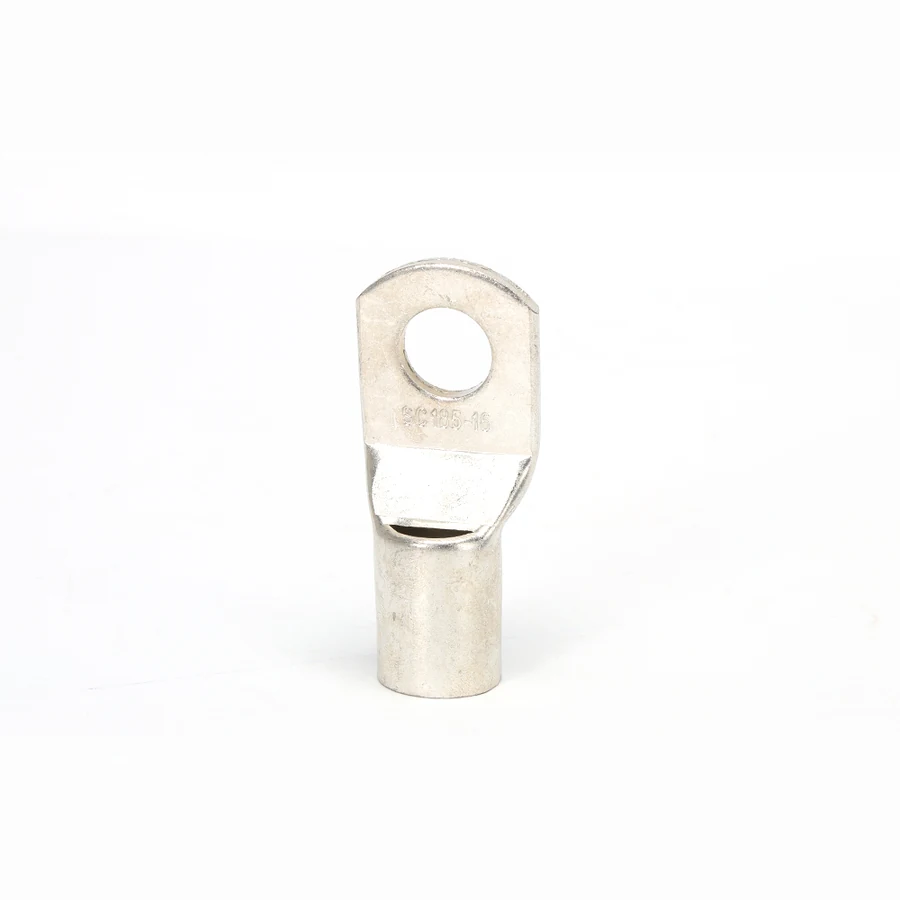
An SC series copper tube terminal: the barrel, tongue hole and overall length are the three dimensions that decide whether a substitute fits the same stud and busbar.
Resolve dimensional and assembly issues before production release
Most sample-stage problems are dimensional and most of them are cheap to fix at that point. Three recur often enough to check deliberately. The tongue is too wide for the terminal block clamp, or too narrow for the stud washer. The barrel length does not match the strip length the tool is set for, so the conductor either bottoms out or stops short. The insulation grip is sized for a cable diameter that the actual cable exceeds, so the sleeve splits during crimping.
A manufacturer with an engineering function will ask for the mating component in the sample request: the terminal block, the stud, the housing. Sending a terminal sample without the mating part is how a project discovers at first build that the assembly does not fit.
Approving a terminal for a new harness?
Send the conductor schedule, mating components and tool data. We will return sample terminals with the crimp window and pull-force data for the exact combination.
Control production continuity after sample approval
Approval is a moment; continuity is the years after it. The controls that matter are the ones that prevent an unannounced change from reaching the line.
Control approved samples, packaging, and engineering changes
An approved sample should be retained by both parties and identified with the date, the drawing revision and the lot. That golden sample is the reference for every later dispute, and it is the only objective way to answer “was this always like this”.
Packaging is part of the specification, not a logistics detail. Reel dimensions, tape pitch, piece orientation and the maximum number of splices per reel all affect whether the line runs. A terminal that arrives in a different packaging format than the approved one can stop an automatic crimper for a shift.
Engineering change control is the third control, and the one to test before placing a long-term order. Ask how the manufacturer notifies customers of a material, plating or dimensional change. A documented product change notification process, with a defined notice period and a first-article requirement after the change, is a stronger quality signal than most certificates.
Request evidence for lead times, traceability, and repeat orders
Lead time should come with its assumptions: raw material, plating, tooling availability and lot size. A quoted four weeks that assumes a copper lot in stock is not the same as a quoted four weeks that assumes nothing, and the difference shows up in the second order rather than the first.
Traceability should be demonstrated, not asserted. Ask for a lot code on the packaging and a route back to the copper lot, the plating batch and the production date. For a BV vinyl insulated butt splice terminal or any part used in a safety-related circuit, that route is what makes a recall scoped rather than total.
Repeat-order consistency is the third evidence item. The practical test is a first-article inspection on the second order, compared against the golden sample: dimensions, plating appearance, crimp performance on the approved tool. If the second order passes without intervention, the process is under control. If it needs a conversation, the first order was a sample and not a production part.
| Support phase | Document to request | What it proves |
|---|---|---|
| Specification | Drawing and sample specification | The part is defined, not just listed |
| Validation | Crimp height and pull-force report | The joint meets a stated criterion |
| Continuity | Golden sample, lot code, PCN process | The approved part stays approved |
The wider commercial comparison — capability, certification, capacity — is set out in key factors when choosing crimp terminal manufacturers. This article deliberately stays on the engineering interface, because that is where most supplier differences actually appear.
Frequently Asked Questions
What drawings and wire data should buyers send for sample approval?
Send the conductor class and strand count, the insulation diameter, the mating component, and the crimp tool you will use in production. A sample request without the mating part and the tool is a request for a catalogue part, not for a validated one.
Why must sample crimps use the approved terminal and tool combination?
Because the crimp is a system, not a part. The same terminal crimped with a different die produces a different crimp height and a different pull force. A sample that was not made with the production tool does not predict production performance.
How should buyers verify certification claims for a chosen terminal?
Ask for the certificate or test report that names the model, not the series, and check the standard edition and scope. For crimped connections the relevant documents are IEC 60352-2, UL 486A-486B and, for power connectors, EN/IEC 61238-1.
What should be checked before approving a crimp terminal for production?
Crimp height within the specified window, pull force against the applicable standard, a cross-section showing compacted strands, correct insulation position, and a dimensional check against the mating component.
How are approved samples, packaging, and later changes controlled?
A retained golden sample identified by date and drawing revision, a packaging specification with reel and pitch data, and a documented change notification process with a defined notice period and first-article inspection after any change.
What evidence supports lead times, traceability, and repeat orders?
Lead time with its assumptions stated, a lot code that traces back to copper and plating batches, and a first-article inspection on the second order compared with the golden sample.
Does a lower unit price reduce total cost?
Only if the crimp yield is unchanged. A terminal that adds one percent scrap or one rework operation per thousand pieces usually costs more than the price difference, and the cost lands in labour rather than in the purchase ledger.
Can a manufacturer support both sample quantities and volume production?
A manufacturer with both tooling and assembly capability can, and the transition should be defined in advance: which packaging changes, which tooling changes, and what first-article inspection applies at the changeover.
Conclusion
The engineering value of a crimp terminal manufacturer is measured in documents: a drawing that defines the part, a crimp report that validates the joint, and a change-control process that keeps the approved part approved. Terminals are cheap; unplanned changes are not. The crimp terminal range is the starting point, but the support behind it is what a harness or panel programme actually buys.
About The Author
Written by the WESTLEC engineering team, Yueqing, Zhejiang, China. WESTLEC manufactures crimp terminals, DIN rail terminal blocks, waterproof cable glands and busbars for low-voltage assemblies under an ISO 9001 quality system, with IEC 60352-2 and UL 486A-486B documentation available on request.
Last reviewed: November 2026
Related Resources
● 10 questions to ask before choosing a crimp terminal manufacturer
● What certifications should a crimp terminal manufacturer provide
● How crimp terminal manufacturers improve production efficiency
● Crimp connectors: types, specs and manufacturer selection guide
● How manufacturers produce high-quality crimp fork terminals
 EN
 PT
