


Quick answer: Butt splice terminals are widely used because one crimped component does a job that otherwise needs a connector pair, a housing and a panel cut-out. They join two wire ends inline, carry their own insulation and strain relief, are colour-coded so the right size is obvious on the bench, produce a gas-tight joint that survives vibration better than a twisted or soldered splice, and cost pennies per point. Seven practical reasons, with the standards and selection data behind each, are set out below.
Walk through any harness shop, service van or assembly line and you will find the same thing: a dispenser box of red, blue and yellow butt splice terminals within arm’s reach. That is not habit, it is economics. When a joint has to be permanent, compact and made in seconds with one tool, the butt splice wins on almost every axis that matters to a production or maintenance engineer.
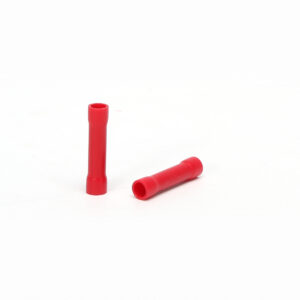 What a butt splice terminal actually does
A butt splice terminal — also called a butt connector, inline splice or butt splice crimp — is a short metal tube with an insulating sleeve. You strip both cable ends, insert one into each end of the tube until the conductors meet in the middle, and crimp each end with the same tool. The result is a permanent inline joint that is electrically continuous, mechanically strong and insulated over its full length.
That is the whole concept, and its simplicity is the first reason it is used everywhere.
1. It joins two wires without a mating half
Every other way of joining two wires needs two components that mate: a plug and a socket, a pin and a receptacle, a terminal block and a conductor. A butt splice needs one part and no mating interface.
That has three consequences that matter in the real world:
- No panel cut-out or mounting space. The joint sits inside the harness, inside conduit, behind a trim panel or inside a junction box. Nothing has to be designed around it.
- No inventory pairing. You do not have to keep male and female halves in stock in matching quantities, and you cannot lose one half of the pair.
- No unmating failure mode. A connector can vibrate loose, back out or be pulled apart. A crimped butt splice cannot come apart unless the conductor or the barrel fails.
2. Insulation and strain relief come in the same crimp
An insulated butt splice is not a bare tube with heat shrink added later. The sleeve is part of the component, it extends past both ends of the metal barrel, and it is gripped by the second crimp of the same tool stroke.
That gives you two functions from one action:
- Insulation rated for the working voltage of the circuit, covering the full length of the joint with no exposed metal.
- Strain relief, because the sleeve grips the cable jacket, so bending and pulling loads are taken by the insulation rather than being transferred to the conductor crimp.
Sleeve material is the main choice here. Vinyl (PVC) sleeves are the general-purpose standard — flexible, low cost, and commonly rated around 75 °C. Nylon (PA66) sleeves run at a higher temperature class, commonly around 105 °C, and resist abrasion and some solvents better. Heat-shrink versions with an internal adhesive layer add a moisture seal for outdoor, marine and under-vehicle work. Always confirm the temperature and voltage rating on the specific datasheet rather than assuming a class.
Our range of vinyl insulated butt splice terminals covers the standard wire ranges in the same three-colour system used across the industry.
3. A correct crimp beats a twisted-and-taped joint
The technical reason butt splices replaced twisted joints in professional wiring is the crimp itself. A proper crimp compresses the conductor strands and the barrel into a cold-welded, gas-tight mass. There is no air gap for oxidation to grow into, so the contact resistance stays low for the life of the installation.
A twisted joint taped with PVC tape does the opposite. It relies on friction, it loosens under thermal cycling as copper relaxes, and it oxidises from the inside out — which is why old taped splices are the classic source of intermittent faults and warm insulation.
Soldering has its own problems in a harness: it creates a stiff section that concentrates bending stress right at the point where the strands enter the solder, it needs skill and heat in the field, and solder can wick up the strand bundle and create a brittle length of wire. That is why crimp is the default in automotive, aerospace and industrial harness standards. We go into the trade-offs in more detail in our comparison of crimping versus soldering.
4. Colour coding removes the guesswork
The red / blue / yellow sleeve colours are not decoration. They are a size system that lets an operator pick the right terminal without reading a part number, and it is the same system on the tool dies — so the terminal and the crimper nest agree by colour.
| AWG | mm² (metric equivalent) | Sleeve colour | Typical min pull force |
|---|---|---|---|
| 22 | 0.34 | Red | 36–51 N |
| 20 | 0.50 | Red | 58–73 N |
| 18 | 0.82 | Red | 85–101 N |
| 16 | 1.5 | Blue | 134–150 N |
| 14 | 2.5 | Blue | 223–230 N |
| 12 | 4 | Yellow | 310–312 N |
| 10 | 6 | Yellow | 356–360 N |
Reference ranges only. Values vary with the standard edition, conductor stranding and terminal design — always confirm against the terminal datasheet. The acceptance criterion that matters in practice is the failure mode, not the number: the conductor should break before it pulls out of the barrel.
5. One tool set covers the whole range
A single ratchet crimper with colour-coded nests handles every size in the table above, plus the ring, fork, pin and blade terminals used elsewhere in the same harness. That is a genuine advantage for field service teams, where the alternative is carrying a soldering iron, a power source and consumables.
Two details separate a good result from a marginal one:
- Crimp height control. Crimp height is measured, not guessed. Typical tolerances are around ±0.05 mm on small terminals and ±0.10 mm on power terminals, verified with a micrometer and a go/no-go gauge. A ratchet crimper will not release until the stroke is complete, which is what prevents the under-crimps that fail later.
- Strip length. Too little and the conductor does not reach the barrel centre; too much and bare copper is exposed outside the sleeve. The datasheet strip length is part of the specification, not a suggestion.
6. The compliance path is short and auditable
For a buyer, one of the most attractive things about butt splice terminals is how quickly a part can be qualified. The relevant standards are well established and the evidence is cheap to produce:
- UL 486A-486B — wire connectors and solder lugs for use with copper conductors, covering pull-out (secureness), temperature rise and dielectric withstand
- IEC 60352-2 — solderless crimped connections, the international counterpart for crimp quality and testing
- EN/IEC 61238-1 — compression and mechanical connectors for power cables, applied at the larger cross-sections
- UL 94 — flammability class of the insulating sleeve
- RoHS and REACH — substance compliance for the plating and sleeve material
- ISO 9001, and IATF 16949 where the harness goes into vehicles
Material is part of that story. Quality butt splice barrels are drawn from ETP copper (C11000, Cu ≥ 99.9%) and tin plated, with plating specified to ASTM B545 service classes. The tin layer is what keeps a fine-stranded conductor from oxidising inside the crimp over years of service.
Specifying butt splice terminals for a production harness?
Send us your conductor sizes, annual volume and target market. Our engineering team will return datasheets, UL and IEC test evidence and production-lot samples you can pull-test on your own bench before you commit.
7. Low piece cost and lower rework risk
The terminal itself is one of the cheapest components in any assembly. The cost that matters is the cost of getting it wrong: a warranty return, a truck roll, a harness pulled out of a machine. Because the crimp is a repeatable process with measurable acceptance criteria, a controlled butt splice line produces fewer field failures than almost any other joining method — and that is ultimately why procurement keeps buying them.
Where butt splice terminals are used every day
| Application | Why a butt splice fits | Sleeve choice |
|---|---|---|
| Automotive and trailer harness | Vibration-resistant inline joints, no bulky connector body | Vinyl as standard; heat shrink under-vehicle |
| Marine and boat wiring | Sealed joint in a salt-spray environment, tinned barrel | Adhesive-lined heat shrink |
| Appliance and HVAC internal wiring | Fast assembly, insulated joint inside a tight enclosure | Vinyl or nylon to suit temperature |
| Industrial control panels and field wiring | Extend or repair a run without re-pulling cable | Vinyl, or nylon for higher ambient |
| Solar and outdoor equipment | UV and moisture exposure, tinned conductor recommended | Adhesive-lined heat shrink |
| Maintenance and repair (MRO) | One size system, one tool, no power required | Vinyl kit boxes |
For wet, buried or under-vehicle locations the insulation class matters more than the barrel. In those cases our waterproof heat shrink butt connectors provide the adhesive seal that a standard vinyl sleeve cannot.
How to choose the right butt splice terminal
Work through these seven checks before you order:
- Conductor size and stranding. Match the terminal to the actual mm² or AWG, and check whether the datasheet covers your stranding class — fine-stranded flexible cable behaves differently in a crimp from a 7-strand building wire.
- Insulation type. Vinyl for general purpose, nylon for higher temperature and abrasion resistance, adhesive-lined heat shrink where moisture reaches the joint.
- Environment. Ambient temperature, salt, fuel, oil, UV and cleaning chemicals all narrow the choice.
- Conductor material. Tinned copper terminals are the safer choice with tinned or fine-stranded conductors, particularly in marine work.
- Voltage rating. Confirm the sleeve rating against the circuit working voltage, including transients.
- Tooling match. The die nest colour must match the sleeve colour, and the crimper must be the ratchet type.
- Documentation. Datasheet with pull-out data, UL or IEC evidence, RoHS and REACH statements, and lot traceability.
A standard general-purpose example is the BV vinyl insulated butt splice terminal, which is supplied in the same red, blue and yellow ranges used across the table above.
When a butt splice is the wrong answer
Being widely used does not mean being universal. Choose something else when:
- The joint must be disconnected later. A butt splice is permanent. Use a mating connector pair.
- The conductor is large. Above the sizes in the table, power work moves to compression splices qualified to EN/IEC 61238-1, installed with a hydraulic tool.
- The cable moves continuously. Drag chains and robotic harnesses need flex-rated cable and strain relief designed for cyclic bending, not an inline crimp.
- Mechanical protection is needed. A butt splice has no shell; in an exposed location it needs a enclosure, loom or moulded boot.
If you are unsure whether you need a splice or a connector at all, our breakdown of butt splice terminal versus butt connector explains where the boundary sits.
Mistakes that cancel out the advantages
Almost every failed butt splice we see in the field comes from one of five causes:
- Wrong size terminal, or a die nest that does not match the sleeve colour
- Twisting the strands before insertion, which changes the fill ratio of the barrel
- Crimping the insulation sleeve in the conductor die, or the conductor in the insulation die
- Joining two different conductor sizes in a barrel that is not rated for that combination
- No pull test on first-off samples, so a bad tool setting runs through a whole shift
A five-sample pull test at the start of every batch, checking that the conductor breaks before it pulls out, catches all five in about two minutes.
Need a second source for butt splice terminals?
WESTLEC supplies vinyl insulated, nylon insulated and heat shrink butt splice terminals with full documentation, mixed-size kitting and OEM packaging. Tell us your sizes and volumes and we will quote from stock or to schedule.
Frequently asked questions
1. What is a butt splice terminal used for?
It permanently joins two wire ends inline. Typical uses are extending a cable run, repairing a damaged section of harness, and building splices into an automotive, marine or appliance loom where a connector pair would be too bulky or too expensive.
2. Are butt splice terminals waterproof?
Standard vinyl or nylon insulated butt splices are not waterproof. For wet, buried, marine or under-vehicle locations use an adhesive-lined heat shrink butt connector, which seals to the cable jacket when heated, or protect the joint inside a rated enclosure.
3. Can you use a butt splice terminal on solid wire?
Yes, most butt splice terminals are rated for both solid and stranded copper conductors, but the rated capacity differs by conductor type. Check the datasheet wire range for solid versus stranded before crimping, and never mix a solid and a stranded conductor in the same barrel unless the datasheet allows it.
4. Do butt splice terminals need heat shrink?
Not if the terminal already has an insulated sleeve, which covers the joint to its rated voltage. Heat shrink is added for abrasion protection, for bundling, or for sealing — and adhesive-lined heat shrink versions combine the seal with the terminal in one part.
5. What size butt splice terminal do I need?
Match the terminal to the conductor cross-section and use the sleeve colour as the cross-check: red for roughly 0.5–1.5 mm², blue for 1.5–2.5 mm², yellow for 4–6 mm². Always confirm against the manufacturer’s wire-range table, because ranges differ between designs.
6. Is crimping better than soldering a butt splice?
For harness and field work, yes. A crimp is faster, needs no heat, is repeatable and does not create the stiff, stress-concentrating section that solder produces at the edge of the insulation. Soldered joints are still used in some electronics work, but crimp is the standard for automotive, marine and industrial wiring.
7. Can you join two different wire sizes?
Only if the terminal is rated for that combination. Some designs accept two smaller conductors in one end, or a step-down pair, but the fill ratio of the barrel has to stay within the design limits or neither conductor will be gripped properly. Check the datasheet rather than forcing the fit.
8. Which standards apply to butt splice terminals?
UL 486A-486B covers wire connectors for use with copper conductors in North America, IEC 60352-2 covers solderless crimped connections internationally, and EN/IEC 61238-1 applies to compression connectors for power cables at larger sizes. Sleeve flammability is classified to UL 94, and substance compliance is covered by RoHS and REACH.
Conclusion
Butt splice terminals are widely used because they solve a common problem with the least possible hardware: one part, one tool stroke, a permanent insulated joint that is easy to inspect and cheap to qualify. Colour coding keeps sizing honest on the bench, the crimp produces a gas-tight connection that outlasts a twisted or soldered splice, and the standards path is short enough that a buyer can approve a part in days.
The two conditions attached to all of that are size matching and crimp control. Get those right and the butt splice is one of the most reliable joints in the harness; get them wrong and no amount of tape will save it.
About the author
This article was written by the WESTLEC engineering team. WESTLEC manufactures low-voltage electrical connection products — crimp terminals including butt splice, ring, fork, pin and blade types, copper tube terminals, rail-mounted terminal blocks, busbars and waterproof cable glands — at our factory in Yueqing, Zhejiang, China, under an ISO 9001 quality management system. Our products are supplied to harness builders, panel builders, distributors and OEMs in Europe, North America, the Middle East and Southeast Asia.
Last reviewed: September 2026. Standards referenced: UL 486A-486B, IEC 60352-2, EN/IEC 61238-1, UL 94, ASTM B545, RoHS, REACH.
Related resources
- How Butt Splice Terminals Ensure Reliable Wire Connections: Complete Guide
- Common Butt Splice Terminal Problems And Solutions
- How To Use Crimp Connectors: Step By Step Guide
- Crimp Connector Types, Wiring Methods And Frequently Asked Questions
- 10 Questions To Ask Before Choosing A Crimp Terminal Manufacturer
 EN
EN  PT
PT 