

Ask a maintenance team what actually kills an outdoor enclosure and the answer is rarely the enclosure itself. It is the hole someone cut in the side of it. Every cable entry is a deliberate breach of a sealed box, and the component that decides whether that breach stays sealed is the cable gland. This article explains the seven benefits an IP68 waterproof cable gland delivers, and — just as importantly — what each benefit actually costs you if you specify a lower rating instead.
What IP68 Actually Means On A Cable Gland
The code is defined by IEC/EN 60529 and it is two independent numbers, not one. Read them separately:
- First digit 6 — solid objects: dust-tight. No ingress of dust whatsoever, verified by an 8-hour test in a dust chamber under vacuum. This is the highest first digit in the standard.
- Second digit 8 — water: protected against continuous immersion in water, under conditions agreed between the manufacturer and the user. IP68 is deliberately open-ended: it must be more severe than IP67 (30 minutes at a depth between 0.15 m and 1 m), but the actual depth and duration belong on the datasheet, not in the code.
That second point is the single most misunderstood detail in cable gland buying. Two glands can both be labelled IP68 while one is rated for 1 m continuous and the other for 10 m. If your application involves standing water, burial or a flood-prone pit, the number you need is not “IP68” — it is the depth-and-duration line on the test report. If you want the full comparison across the lower codes, read our breakdown of how IP68 compares with IP65, IP66 and IP67.
The Seven Benefits At A Glance
| Benefit | What produces it | What to check on the datasheet |
|---|---|---|
| Continuous immersion protection | Compression seal on cable sheath plus body-to-enclosure gasket | Stated depth & duration, not just “IP68” |
| Dust-tight sealing | First digit 6, verified in a dust chamber | IP6X test report, seal material hardness |
| Strain relief and cable retention | Clamping ring or claw gripping the sheath | EN/IEC 62444 tensile class and torque values |
| Corrosion and UV resistance | Body material matched to the site chemistry | PA66 UV-stabilised, nickel-plated brass or SS316 |
| Lower lifetime cost | Fewer call-backs, re-terminations and panel swaps | Seal service life, re-torque intervals, spares cost |
| Temperature and chemical stability | Elastomer seal chosen for the actual environment | Operating range and chemical compatibility list |
| Audit and market access | Third-party testing to recognised standards | IEC 60529, EN/IEC 62444, UL 514B, ATEX/IECEx |
1. Continuous Immersion, Not Just A Dunk
IP67 certifies survival of a temporary immersion. IP68 certifies that the gland is designed to stay sealed while submerged indefinitely, which is a completely different engineering problem. A short dunk is survived by a seal that happens to fit tightly; continuous immersion requires a seal that holds its compression force while it is wet, cold, and under hydrostatic pressure for years.
Two design features do the work. The first is the clamping seal: a tapered elastomer ring compressed by the dome nut so that it grips the cable sheath around its full circumference. The second is the body gasket or O-ring that seals the gland body against the enclosure wall. Both must be sized to the actual cable diameter — a 10 mm cable in a gland set up for 6–12 mm will seal, the same cable in a 3–6.5 mm gland will not.
This is the benefit that matters in flood-prone cable pits, buried junction boxes, below-grade pump chambers, washdown bays with standing water on the floor, and any installation where the enclosure will sit in water rather than be splashed by it. Our IP68 waterproof cable gland range covers metric, PG and long-thread bodies in both nylon and brass, so the entry can be matched to the wall thickness and thread standard the enclosure was actually drilled for.
2. Dust-Tight Sealing, Not Just Water Sealing
Buyers obsess over the second digit and ignore the first. In many industrial sites the first digit is the one that fails you.
An IP6X rating means no dust enters at all. That matters because fine conductive dust — carbon from brake and clutch wear, metal swarf, graphite, cement kiln dust, flour and grain dust in food plants — does not merely make a termination dirty. It bridges creepage distances, tracks across terminal blocks, and produces leakage currents that end in a burned terminal or a nuisance trip. Dust that settles on a warm termination also holds moisture against it, which turns a dry fault into a corrosion fault.
Worth noting: an IP68 gland is also IP6X, because the first digit is independent of the second. A gland sold as “IP67” gives you the same first digit, but a gland sold on a water-jet claim alone (IP65, IP66) may not have been dust-chamber tested at all. If your site generates conductive dust, the first digit is the one to interrogate.
3. Strain Relief That Protects The Termination
A cable gland does two jobs, and the second one is almost always underspecified. It seals the entry, and it anchors the cable so that any pull, vibration or weight on the cable is absorbed by the gland body rather than by the conductor termination.
Consider what happens without it. A 4 mm² conductor terminated into a spring cage terminal block is held by a few newtons of spring force. Hanging two metres of cable off that termination, or letting a machine vibrate next to it for six months, will work the conductor loose. The failure looks like a terminal block problem and gets blamed on the terminal block — but the root cause was at the cable entry.
This is what EN/IEC 62444 (which replaced EN 50262) covers. It is the product standard for cable glands for electrical installations and it sets out the mechanical tests that separate a real gland from a shaped piece of plastic: cable retention (tensile) testing, torque testing on the thread and dome nut, impact resistance, and bending resistance — all followed by re-verification of the ingress protection rating, because a gland that seals before the test and leaks after it has failed.
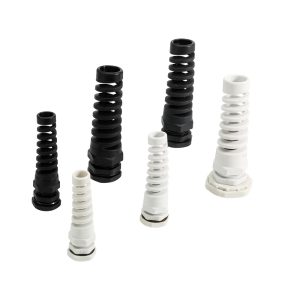
Where the mechanical load is high — trailing cables, mobile equipment, long vertical drops, machinery with constant vibration — the claw design is the one to ask for. A brass long-claw IP68 cable gland grips the sheath over a longer contact length than a standard compression ring, which spreads the clamping load and reduces the chance of the seal cutting into the sheath.
4. Corrosion And UV Resistance At The Weakest Point
The gland is usually the most exposed metal or polymer on an outdoor enclosure. It protrudes, it is handled, it sits at the point where water collects. Material choice here decides whether the entry is still serviceable in five years or has to be cut out.
| Body material | Strengths | Watch out for | Typical applications |
|---|---|---|---|
| PA66 nylon, UV-stabilised | Low cost, light, electrically insulating, good chemical resistance, no galvanic issue with aluminium enclosures | Lower mechanical strength; verify UV stabilisation and UL94 flammability class | Solar junction boxes, outdoor lighting, light industrial panels |
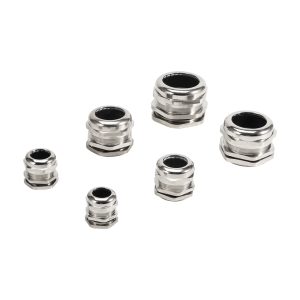
| Nickel-plated brass | High mechanical strength, good thread wear resistance, excellent EMC continuity when used with a contact washer | Galvanic corrosion if paired with aluminium without protection; plating quality varies — ask for salt spray hours | Machinery, marine and coastal, heavy industrial |
| Stainless steel AISI 316 | Best corrosion resistance, including chlorides and de-icing salts | Highest cost; galling risk on threads — use correct lubrication and torque | Offshore, chemical plant, food and beverage washdown, coastal infrastructure |
Two verification questions belong on every RFQ. For metal bodies: how many hours of neutral salt spray to ISO 9227 (or ASTM B117) has the plating been tested for? For polymer bodies: has the material been UV-aged to ISO 4892, and is the grade confirmed as UV-stabilised rather than natural? A non-stabilised nylon gland in direct sun will chalk and lose impact strength long before it leaks — which is worse, because the failure is invisible until someone touches it.
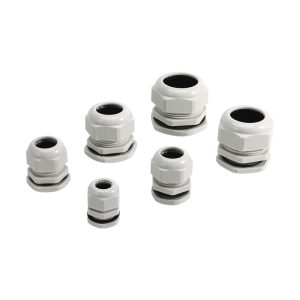
For general outdoor and light industrial duty, a PA66 nylon IP68 cable gland is usually the right value point: insulating, corrosion-proof, and light enough that it does not stress thin enclosure walls.
Specifying glands for a project that has to last?
Send us the enclosure material, wall thickness, cable diameters and the site conditions. Our engineers will confirm the thread standard, body material and seal compound before you commit to a BOM — and flag any entry where IP68 is more than the application needs.
5. Lower Lifetime Cost Than The Unit Price Suggests
A gland is a low-value line item, which is exactly why it gets value-engineered badly. The purchase price is visible on the BOM; the cost of the failure it prevents is not.
Run the arithmetic on a single outdoor junction box in an industrial plant. An IP68 gland might cost a small multiple of an unrated one — the delta on a twelve-entry box is immaterial. The cost of one failure is not: a call-out, an electrician’s hour, a re-termination, and in a process plant possibly hours of downtime. On any installation where access is difficult — a rooftop, a mast, a buried pit, a tunnel — the first avoided call-back pays for every gland on the job.
Use this structure with your own numbers rather than a generic multiplier:
| Cost line | IP68 specification | Lower-rated specification |
|---|---|---|
| Gland unit cost × quantity | Your figure | Your figure |
| Installation labour | Identical if thread and size match | Identical if thread and size match |
| Inspection and re-torque over service life | Scheduled, predictable | Often reactive |
| Probability of moisture ingress over 10 years | Low, with correct sizing | Site-dependent, higher outdoors |
| Cost per ingress event (labour + parts + downtime) | Your figure | Your figure |
| Expected number of events over 10 years | Your estimate | Your estimate |
| Total |
Fill the last two rows with your own maintenance history and the conclusion usually inverts: the gland is not where the money is saved. Sizing, torque and seal material are where the money is saved, and all three are free to get right.
6. Stable Sealing Across Temperature And Chemicals
An ingress rating is measured on a new gland at room temperature. Real service is neither. The elastomer seal is the part that sees it all, and it is the part most often chosen by default.
| Seal material | Typical operating range | Good with | Avoid |
|---|---|---|---|
| NBR (nitrile) | −30 °C to +100 °C | Oils, fuels, greases, general industrial | Ozone, weathering, strong sunlight |
| EPDM | −40 °C to +120 °C | Weathering, ozone, UV, water, steam, glycol | Mineral oils, hydrocarbons, fuels |
| Silicone | −60 °C to +200 °C | Extreme temperature range, food contact grades | Fuels, some solvents; lower tear strength |
| TPE | −40 °C to +110 °C | General purpose, cost-sensitive outdoor duty | Aggressive solvents, high-temperature oil |
Ranges above are typical published values and vary by compound and manufacturer — always confirm against the specific datasheet. Two mechanisms do the damage. Compression set is the seal’s loss of ability to spring back after years of compression; once it takes a permanent set, the clamping force drops and the gland weeps. Thermal cycling is worse than steady temperature: a sheath that expands and contracts daily against a hardened seal will pump moisture along the cable over time, a mechanism that no static test catches.
 This is why the material question should be asked in terms of the site, not the catalogue: is there oil mist, is there ozone from nearby motors, does the enclosure see direct sun on one face, is there a washdown cycle with hot water or caustic? The right seal is the one matched to those answers.
7. Certification That Clears Audits And Borders
For a B2B buyer the seventh benefit is procedural, and it is often the one that decides the order. An uncertified gland is a component your customer’s auditor can reject, your insurer can question, and your export paperwork can stall on.
The standards that legitimately apply to a cable gland:
- IEC/EN 60529 — the IP code itself. The test report should state the depth and duration for the second digit 8.
- EN/IEC 62444 — the cable gland product standard: mechanical and sealing performance, marking and classification. Supersedes EN 50262.
- UL 514B — the North American fitting standard where the assembly is shipped to the USA or Canada; UL 50E may additionally apply to the enclosure opening.
- ATEX / IECEx with EN IEC 60079 — Ex e (increased safety) and Ex d (flameproof) glands for hazardous areas. These are certified as part of an assembly, not as loose components.
- RoHS and REACH — material substance compliance, required for EU placement and increasingly requested by OEMs elsewhere.
- ISO 9001 at the manufacturing site — the process evidence behind the test reports.
The practical advice is to ask for the test report number and the issuing laboratory, not the certificate logo. A supplier who can produce a dated report from a named laboratory is a different proposition from one who can produce a PDF badge. If you are building a supplier shortlist, our guide to verifying waterproof cable gland suppliers covers what to request and what a genuine answer looks like.
 When IP68 Is Not Worth Paying For
Specifying IP68 everywhere is not diligence, it is a different kind of mistake. Some cases where the money is better spent elsewhere:
- Dry indoor control panels. If the enclosure is IP54 in a conditioned room, an IP54–IP65 gland with correct strain relief is the correct part.
- High-pressure, high-temperature washdown. Food and beverage lines that are jet-cleaned at 80 °C need IP69K per ISO 20653, which is a different test from the IEC 60529 second digit — IP68 does not automatically cover it.
- Very small enclosures with thin walls. A heavy brass gland on a 1.5 mm polycarbonate wall creates a lever arm and a thread-engagement problem. A nylon gland with a locknut is often the better engineering answer.
- Where a conduit system already does the sealing. Sealed conduit with a certified fitting may remove the need for a high-rated gland entirely.
The honest version of this article is that IP68 is not a quality grade, it is a fitness-for-purpose grade. It pays for itself exactly where water or conductive dust will be present for long periods, and nowhere else.
How To Specify An IP68 Gland On Your Next RFQ
Eight fields are enough to get an accurate quote and, more importantly, to get the right part:
- Thread — metric (M12–M63), PG, NPT or G/BSPP, plus the required thread length for the wall thickness.
- Cable outside diameter range — measured, not nominal from the cable type. This is the single most common cause of a leaking IP68 gland.
- Body material — PA66, nickel-plated brass or stainless steel, with the UV or salt-spray requirement.
- Seal material — NBR, EPDM, silicone or TPE, matched to temperature and site chemistry.
- Operating temperature range — including cycling, not just the extremes.
- Mechanical requirement — cable retention class where vibration or cable weight is present.
- Certifications — IEC 60529 depth/duration, EN/IEC 62444, UL 514B, ATEX/IECEx, RoHS/REACH.
- Quantity, packaging and marking — loose, bagged, part-number printed, private label.
Installation is the other half of the equation. An IP68 gland installed at the wrong torque, on an out-of-range cable, or with the dome nut cross-threaded will not hold its rating. Our step-by-step guide to installing IP68 waterproof cable glands sets out the sequence and the torque checks.
Need samples for an incoming qualification?
Tell us the cable diameters, thread standard and site conditions. WESTLEC will ship sample glands with the relevant test documentation so your team can verify the rating on your own cable before the BOM is frozen.
Frequently Asked Questions
1. What does IP68 actually mean for a cable gland?
Dust-tight (first digit 6) and protected against continuous immersion in water under conditions specified by the manufacturer (second digit 8). Unlike IP67, which is defined as 30 minutes at 0.15–1 m, IP68 has no fixed depth or duration in the standard — those figures must be read off the gland’s own datasheet and test report.
 2. Is IP68 always better than IP67?
For standing water and burial, yes. But IP68 is only meaningful with a stated depth and duration, and a well-made IP67 gland correctly sized to the cable will outperform a poorly installed IP68 one. Installation quality and cable diameter match dominate the rating in practice.
3. Can an IP68 cable gland be used permanently underwater?
Only if the manufacturer’s rating covers the depth and duration involved — that is precisely what the second digit 8 delegates to the datasheet. For any permanent submersion application, get the test report and confirm the seal material is rated for continuous water contact at the site temperature.
4. Does IP68 cover high-pressure washdown?
Not automatically. High-pressure, high-temperature jet cleaning is covered by IP69K per ISO 20653, which is a different test from the IEC 60529 second digit. Food and beverage plants should specify IP69K explicitly rather than assuming IP68 is sufficient.
5. Nylon or brass for an IP68 gland?
Nylon PA66 suits cost-sensitive outdoor and light industrial work, is corrosion-proof and avoids galvanic problems with aluminium enclosures. Nickel-plated brass suits high mechanical load and EMC continuity requirements. Stainless steel 316 is specified for coastal, offshore, chemical and washdown duty.
6. What causes an IP68 gland to leak?
Almost always one of three things: the cable outside diameter falls outside the gland’s stated clamping range, the dome nut is under- or over-torqued, or the seal has taken a compression set after long service or thermal cycling. Incorrect thread length for the wall thickness is a close fourth.
7. Do IP68 glands need maintenance?
They need inspection rather than maintenance. Check for dome nut loosening after the first thermal cycle and at scheduled intervals, look for seal cracking or flattening, and plan seal replacement on a service interval in continuously immersed or high-cycling installations rather than waiting for a leak.
8. Which certifications should a B2B buyer require?
At minimum an IEC/EN 60529 test report stating the IP68 depth and duration, and EN/IEC 62444 for mechanical and sealing performance. Add UL 514B for North America, ATEX/IECEx under EN IEC 60079 for hazardous areas, and RoHS/REACH documentation for EU placement. Always ask for the report number and issuing laboratory.
About The Author
This article was prepared by the WESTLEC engineering team in Yueqing, Zhejiang. WESTLEC manufactures low-voltage electrical connection components — cable glands, terminal blocks, crimp terminals and waterproof enclosures — under an ISO 9001 quality management system, and supplies OEM, panel-building and distribution customers in Europe, North America, the Middle East and Southeast Asia. Ratings and standards referenced: IEC/EN 60529, EN/IEC 62444, UL 514B, EN IEC 60079, ISO 9227, ISO 4892, ISO 20653.
Last reviewed: September 2026. Values quoted are typical published figures; always confirm against the specific product datasheet before finalising a specification.
 EN
EN  PT
PT