

A pin terminal is a small part with an outsized job. It turns a stranded conductor into a rigid, round pin that can be inserted into a terminal block clamp, and it does so in a space where a ring terminal will not fit and a bare ferrule gives no insulation. The insulation on that pin is often chosen by habit — colour-matched to the wire, whatever the last project used — when it is actually a temperature, chemical and mechanical decision.
This article compares the two insulation families used on insulated pin terminals, vinyl (PVC) and nylon (PA66), and then looks at the part that is usually ignored: the interface between the pin and the terminal block it enters. Both halves decide whether the connection is reliable.
Insulated Pin Terminals: Vinyl vs Nylon Insulation
The comparison only becomes useful when the three components of a pin terminal are separated, because vinyl and nylon are not interchangeable across all three. The pin is metal and does not change. The barrel is metal and does not change. Only the sleeve changes, and the sleeve has three jobs: electrical insulation, mechanical protection of the crimp, and a visual and tactile indication of wire size.
Define the pin contact, crimp barrel, and insulating sleeve separately
The pin contact is the part that enters the terminal block. Its diameter and length have to match the clamp opening and the depth behind it. A pin that is too short does not reach the clamping point; a pin that is too long bottoms out and leaves the clamp pressing on the shoulder rather than the pin.
The crimp barrel is the part that receives the conductor. It has a conductor crimp and, on better designs, a separate insulation crimp that grips the wire insulation rather than the strands. That second crimp is what stops the conductor moving when the cable is flexed, and it is the reason two pin terminals with the same pin diameter can behave very differently in service.
The sleeve is the part that is being compared. On a vinyl pin terminal it is a moulded PVC sleeve over the barrel and part of the pin. On a nylon pin terminal it is a moulded PA66 sleeve with the same geometry and a different material. The geometry is often identical; the temperature and chemical behaviour are not.
Distinguish insulated pin terminals from cord-end ferrules
The two are frequently confused because both are inserted into terminal blocks and both come in colour-coded sizes. They are different products with different functions.
A cord-end ferrule is a thin-walled tube that is crimped onto a fine-stranded conductor to consolidate the strands. Its colour code indicates the conductor size, and its insulation, where present, is a collar rather than a sleeve. It does not provide a rigid pin, it does not protect the crimp from handling, and it is not designed to be inserted and removed repeatedly.
An insulated pin terminal has a solid pin, a barrel with a defined crimp zone, and a sleeve that covers both. It is the right choice where the conductor has to enter a clamp that is not designed for a bare stranded wire, where the joint will be handled during assembly, or where a finger-safe barrier is required. The vinyl insulated pin terminal range is built for that duty, with the PTV sizes covering 0.5–6 mm².
Compare insulation behaviour under the intended service conditions
Vinyl and nylon are both thermoplastics, and both are adequate at room temperature. The difference appears at the edges of the operating envelope, and those edges are reached more often than most panel specifications admit.
Compare vinyl (PVC) and nylon using exact pin-terminal specifications
The PTV insulated pin terminal data gives a concrete comparison because the sizes, currents and dimensions are published:
| Model | Conductor range | Current | Pin diameter | Overall length | Colour |
|---|---|---|---|---|---|
| PTV 1.25 | 0.5–1.5 mm² (AWG 22–16) | 19 A | 1.7 mm | 16.0 mm | Red |
| PTV 2 | 1.5–2.5 mm² (AWG 16–14) | 27 A | 2.3 mm | 16.0 mm | Blue |
| PTV 5.5 | 4–6 mm² (AWG 12–10) | 48 A | 3.4 mm | 20.5 mm | Yellow |
The current ratings are the same for both insulation families, because the metal carries the current. What changes is the temperature the sleeve will tolerate continuously, and what happens to it when that limit is exceeded. Vinyl softens progressively; it does not fail at a single temperature but deforms, which loosens the grip on the barrel and exposes the crimp. Nylon holds its shape to a higher temperature and resists abrasion better, which is why it is the default where the terminal sits near a heat source or where the loom is handled repeatedly.
Verify temperature and chemical ratings from the exact part datasheet
Do not transfer a temperature rating from one pin terminal to another. Two parts with the same colour and the same pin diameter can have different sleeve compounds, and the datasheet for the exact model is the only reliable source.
Three ratings deserve specific attention. The continuous temperature rating is the one that matters for a panel that runs warm; a vinyl sleeve rated around 75 °C and a nylon sleeve rated around 105 °C are not interchangeable in a cabinet that reaches 85 °C internally. The short-term or excursion rating covers soldering, heat-shrink nearby, or a fault condition, and it is usually higher than the continuous value. The chemical rating covers oils, fuels, cleaning agents and refrigerants, and it is where nylon generally has the advantage.
For a vinyl pin terminal the practical limits are well known: good general-purpose insulation, adequate flexibility, limited heat resistance, and sensitivity to some solvents. For nylon, the trade is higher temperature and abrasion resistance against higher cost and slightly greater stiffness. Neither is universally better.
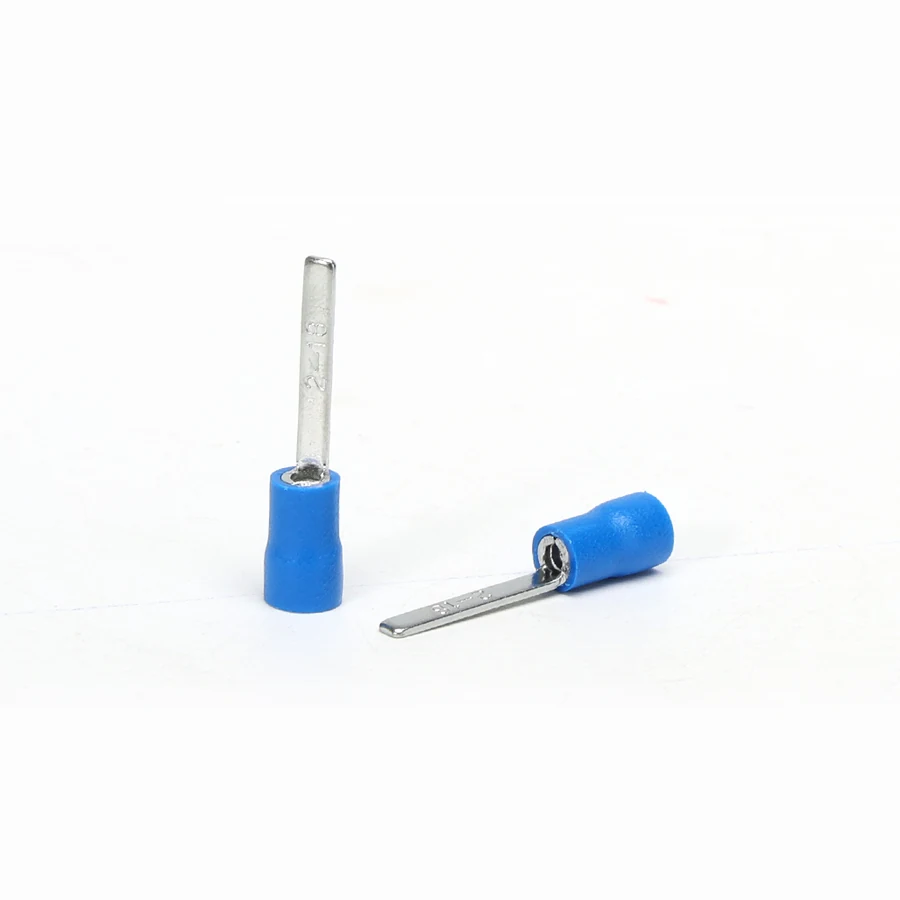
PTV pin terminals in red, blue and yellow: conductor range, pin diameter and overall length are the three dimensions that have to match the receiving clamp.
Matching a pin terminal to a terminal block?
Send the terminal block model and the conductor range. We will confirm the pin diameter and length that the clamp actually accepts.
Check the crimp construction and receiving-terminal interface
The insulation is the visible choice; the crimp and the interface are the ones that decide whether the connection works. Both are specified on the drawing and both are frequently left to the supplier’s default.
Check normal, easy-entry, and copper-sleeve constructions
The PTV family is offered in three constructions, and the difference is worth understanding before specifying by part number alone.
The normal construction is the standard pin and barrel, suitable for most panel wiring where the conductor is inserted once. The easy-entry variant has a chamfered or funnel-shaped barrel entry that guides a stranded conductor into the crimp zone, which reduces the chance of a stray strand and speeds up assembly. It costs slightly more and is usually worth it on fine-stranded wire.
The copper-sleeve variant adds a copper sleeve inside the barrel, which changes how the crimp compacts the conductor. It is used where the crimp needs to be more forgiving of strand variation, or where the joint will be inspected by cross-section. The trade is a slightly different crimp height window, which means the tool setting has to match the construction, not just the size.
Whichever construction is chosen, the crimp has two zones: the conductor crimp and the insulation crimp. A pin terminal crimped only on the conductor will pass a pull test and still allow the wire to flex at the barrel mouth, which is where fatigue failures start.
Match pin length, pin diameter, and wire range to the receiving clamp
The receiving terminal block sets three constraints, and all three are dimensional.
Pin diameter has to sit inside the clamp opening with enough clearance to enter and enough contact to carry the current. A 1.7 mm pin in a clamp designed for 2.3 mm may not develop full contact pressure; a 3.4 mm pin in a 2.3 mm clamp will not enter at all.
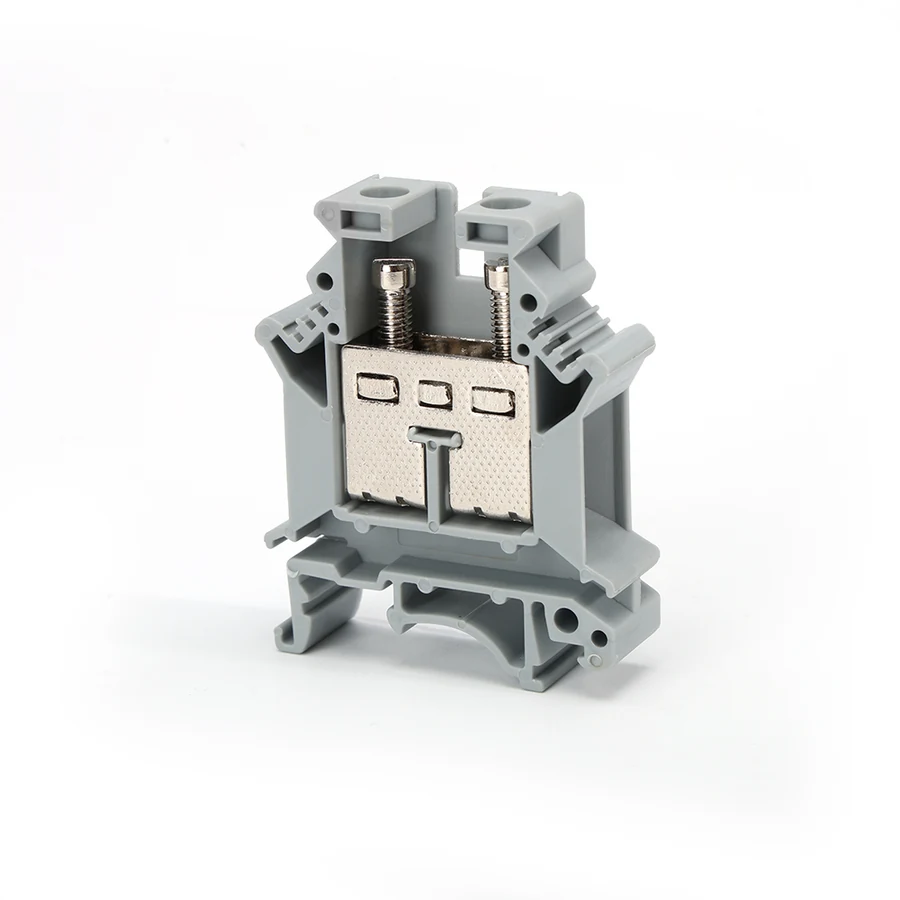
For any pin terminal for terminal block entry, length has to reach the clamping point without bottoming out. In a screw clamp the pin sits under the screw; in a spring or push-in clamp it passes a release mechanism. A pin that is too short sits behind the clamp and makes contact only by friction, which is invisible and unreliable.
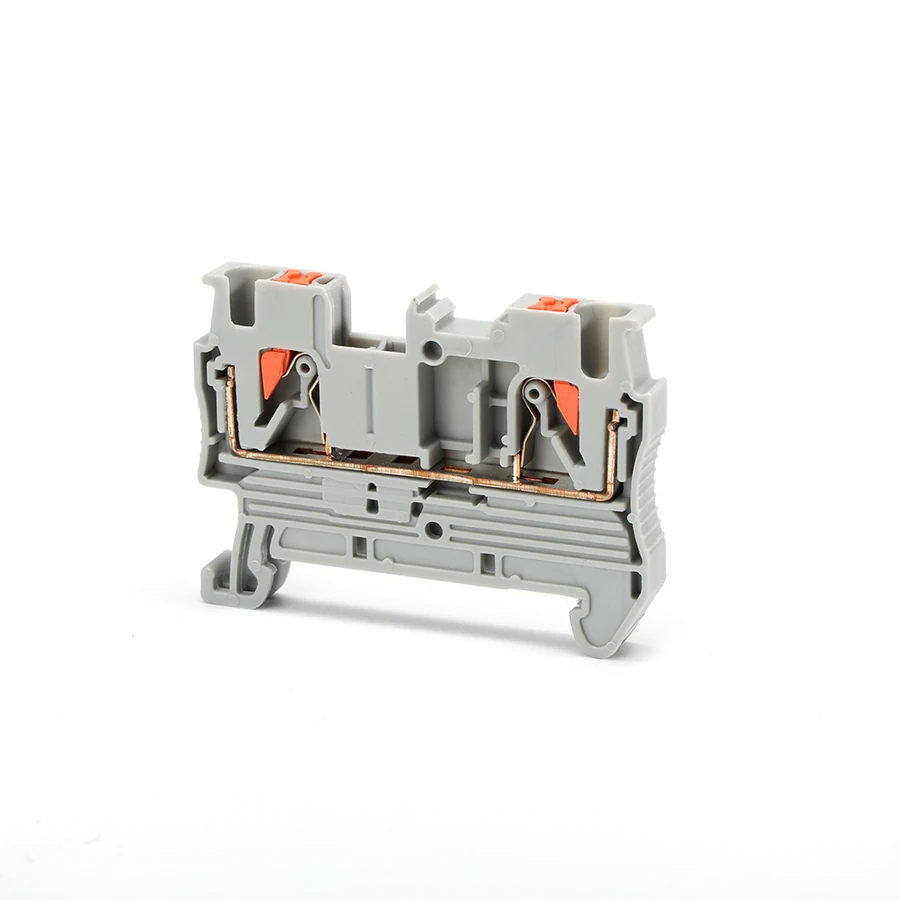
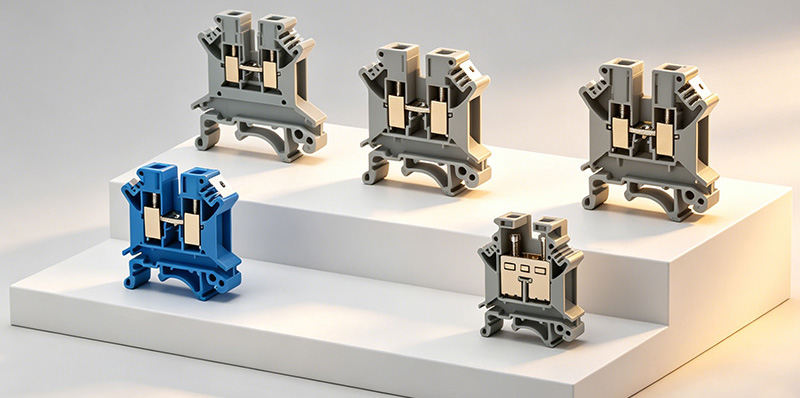
Wire range has to match the barrel, and the current rating of the terminal block has to cover the pin terminal’s rating. A 48 A PTV 5.5 in a terminal block rated 24 A moves the limit to the block, not the pin. The receiving side is covered in DIN rail screw connection terminal blocks, where the clamp designation and the rated current are stated per model.
Make an application-based choice between vinyl and nylon
The choice is rarely about preference. It follows from three questions: how hot the terminal gets, how much handling it sees, and whether the part is available in the size the drawing requires.
Balance protected panel wiring against flex, handling, and inspection needs
Vinyl is the right default for protected panel wiring: conductors inside a duct, terminals that are inserted once, and an ambient that stays within the sleeve rating. It is also the lower-cost option and the one most widely stocked, which matters when a project needs a size quickly.
Nylon earns its place in three situations. Where the terminal is close to a heat source — a contactor coil, a resistor, a power supply — the higher continuous rating gives margin. Where the loom is handled during assembly or maintenance, the abrasion resistance protects the crimp. And where the panel is subject to cleaning agents or oils, the chemical resistance is better.
Neither material solves a mechanical problem. A pin terminal that is pulled sideways out of a clamp will fail regardless of the sleeve, and a crimp made with the wrong die will pull out of the barrel before the sleeve matters.
Verify nylon options against model or inquiry data, not assumptions
This is the step that most specifications skip. Vinyl pin terminals are a stocked, catalogued family with published sizes, while nylon insulated pin terminals are usually a subset of the range. Nylon versions are often available but not necessarily in every size, and not necessarily with the same pin diameter and length.
The correct approach is to ask for the model data before writing the part number into a drawing. Three questions cover it: which sizes are available in nylon, whether the pin dimensions match the vinyl equivalent, and what the crimp tool setting is for the nylon version. A nylon sleeve can change the crimp height window because the sleeve sits in the tool die differently, and a tool setting carried over from vinyl may not produce the same crimp.
Where a nylon part is not available in the required size, the options are to change the terminal block to accept a different pin diameter, to move the joint away from the heat source, or to accept the vinyl part with a documented temperature margin. All three are engineering decisions; none of them should be made by substituting a part number on a purchase order.
| Selection question | Vinyl (PVC) | Nylon (PA66) |
|---|---|---|
| Continuous temperature | Around 75 °C, 105 °C variants | Around 105 °C |
| Abrasion and handling | Adequate in ducts | Better resistance to repeated contact |
| Chemical resistance | Limited with some solvents | Better general resistance |
| Availability | Catalogued, wide size range | Model or inquiry specific |
| Relative cost | Lower | Higher |
The broader comparison of insulated and non-insulated terminals is covered in insulated vs non-insulated terminals, and the terminal family overview sits in electrical terminal types for industrial users.
Need a nylon pin terminal in a specific size?
Send the model, pin diameter and conductor range. We will confirm what is available in PA66 and what the equivalent vinyl part covers.
Frequently Asked Questions
When should I choose nylon pin terminals over vinyl?
When the terminal runs near a heat source, when the loom is handled repeatedly, or when cleaning agents and oils are present. Nylon’s higher continuous temperature and better abrasion resistance justify the cost in those conditions and add little elsewhere.
Are vinyl or nylon insulated pin terminals suitable for outdoor or wet use?
Neither is a sealed connector. Both insulate the crimp, but water can enter at the sleeve ends. For outdoor or wet locations, use a sealed splice or a housing connector rather than relying on the sleeve.
What is a double crimp and why does it matter on a pin terminal?
A double crimp has separate conductor and insulation crimp zones. The conductor crimp holds the strands; the insulation crimp grips the wire jacket and provides strain relief. Without it, flexing concentrates at the barrel mouth and the joint fatigues.
How do I know what size insulated pin terminal I need?
Match three dimensions: the conductor range to the wire, the pin diameter to the terminal block clamp, and the pin length to the depth of the clamp. Current rating then confirms the choice against the circuit load.
How do pin terminals differ from cord-end ferrules?
A ferrule consolidates strands into a tube and is crimped for a terminal block. A pin terminal has a rigid solid pin, a defined crimp barrel and an insulating sleeve, so it can be inserted and removed repeatedly and provides a finger-safe barrier.
Do nylon pin terminals always accept a double crimp?
Not necessarily. The sleeve geometry affects how the tool die closes, so the crimp construction has to be confirmed per model. Ask for the tool setting rather than assuming the vinyl setting applies.
Can I use a pin terminal in a push-in terminal block?
Often yes, provided the pin diameter and length suit the clamp and the block accepts a pin entry. Confirm against the terminal block datasheet; a push-in clamp designed for a bare conductor may not grip a plated pin with the same force.
What happens if the pin is too short for the clamp?
The clamp closes behind the pin and contact is made by friction rather than by design. The joint may pass a continuity check and fail under load or vibration, and the fault is difficult to see after assembly.
Conclusion
Vinyl and nylon pin terminals are the same product in two materials, and the choice between them is a service-condition decision rather than a quality ranking. Vinyl covers protected panel wiring at lower cost. Nylon buys temperature margin, abrasion resistance and chemical resistance where the application needs them, at a higher price and with narrower availability.
The part that decides reliability, though, is the interface: pin diameter, pin length and clamp design. Get those three right and either insulation will perform. Get them wrong and neither will.
About The Author
Written by the WESTLEC engineering team, Yueqing, Zhejiang, China. WESTLEC manufactures insulated pin terminals, butt connectors, DIN rail terminal blocks and cable glands under an ISO 9001 quality system, with IEC 60352-2 and UL documentation available on request.
Last reviewed: November 2026
Related Resources
● How vinyl insulated ring terminals improve electrical safety
● How to choose the right size non-insulated ring terminal
● Female crimp connector size guide: AWG, pitch and wire compatibility
● Non-insulated electrical terminals vs insulated ring terminals
 EN
 PT