


A vinyl insulated butt connector does two jobs and is usually credited with three. It joins two conductors, it insulates the joint, and it is often assumed to seal it. The first two are properties of the product. The third is a property of the system, and a vinyl sleeve on its own is not a system.
That distinction matters because the failure is slow and invisible. A splice that admits moisture does not fail at installation; it fails after a season of thermal cycling, when the copper inside the barrel has turned green and the resistance has climbed. This article sets out what a vinyl splice actually covers, where water gets in, and how to decide between keeping it, protecting it, or replacing it with a sealed connector.
When Vinyl Insulated Butt Connectors Are Not a Sealed or Moisture-Blocked Splice
The product category is honest about its construction: a tin-plated copper barrel with a vinyl (PVC) sleeve moulded over it. The sleeve is an insulator with a dielectric function. It is not a gasket, it is not heat-shrinkable, and it does not bond to the wire insulation.
Explain what BV vinyl insulation covers and what it does not seal
The BV vinyl insulated butt splice terminal range illustrates the construction clearly. Each size is defined by conductor range, barrel dimensions and current: BV 1.25 for 0.5–1.5 mm² (AWG 22–16) at 19 A, BV 2 for 1.5–2.5 mm² at 27 A, BV 5.5 for 4–6 mm² at 48 A, and upwards through BV 38 for 35–50 mm² at 160 A. The colour code — red, blue, yellow — maps to the size, which is why the range is so widely used in panel and harness work.
What the sleeve provides is electrical insulation over the barrel and a defined insertion stop for the conductor. What it does not provide is a barrier at either end. The sleeve ends in an open annular gap around the wire insulation, and that gap is the entry point. On a crimped joint the sleeve is compressed against the barrel, not against the insulation, so there is no sealing contact to speak of.
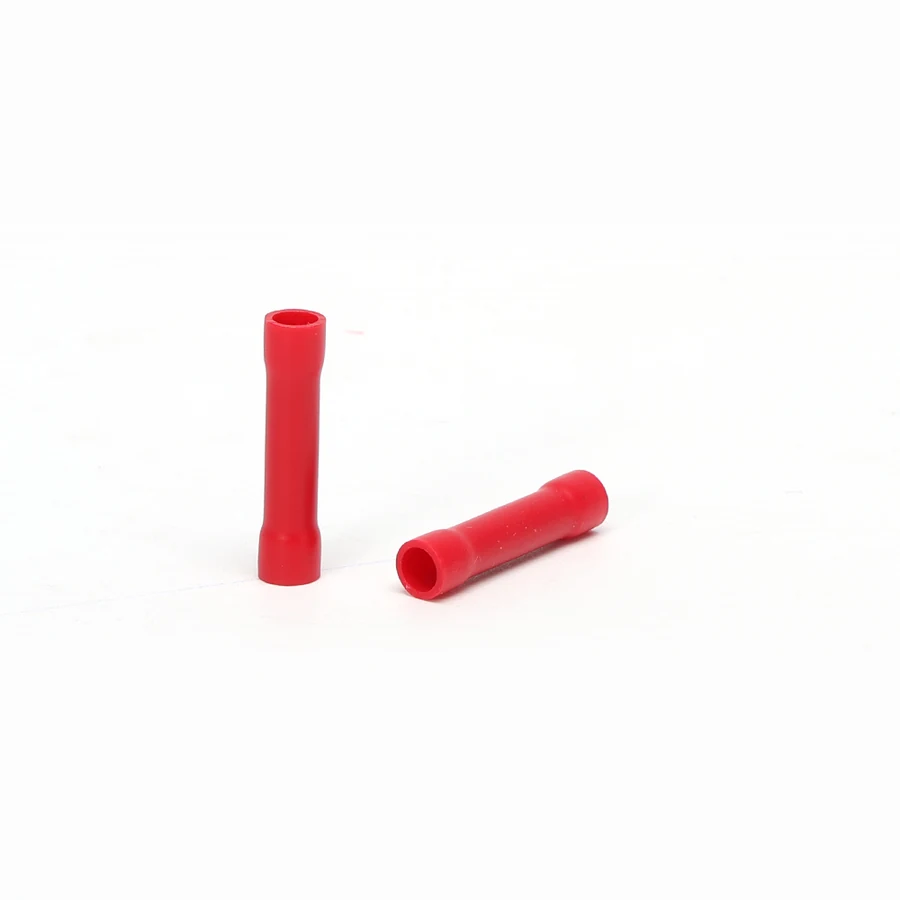
BV vinyl insulated butt splice terminals: the sleeve covers the barrel and gives an insertion stop, but the open ends are not a seal.
A second limitation is thermal. Vinyl is a thermoplastic with a continuous rating typically around 75 °C, with 105 °C variants available. It deforms under sustained heat and it melts if a heat source is applied. That matters because the instinctive fix for a wet splice — run a heat gun over it — destroys the insulation instead of sealing it.
Trace water entry along the sleeve, wire insulation, and conductor strands
Water reaches a splice by four routes, and only one of them is visible.
The first is the open end of the sleeve, where capillary action pulls water between the sleeve and the wire insulation. The second is along the interface between the wire insulation and the copper conductor, which is not bonded on a standard insulated wire. The third is through the conductor itself: a stranded conductor wicks moisture along its length, so water can enter a metre away and arrive at the splice from inside. The fourth is condensation, which needs no entry path at all — a sealed enclosure with a temperature cycle will produce water on the coldest surface, and a splice is often the coldest small object in the box.
The same path explains why electrical butt splices that pass a continuity check at installation can fail a resistance check a year later. Moisture plus copper plus oxygen produces corrosion, corrosion raises resistance, resistance produces heat, and heat accelerates the corrosion. In a low-current signal circuit the result is an intermittent fault that resists diagnosis. In a power circuit the result is a warm joint and, eventually, a failure at the least convenient moment.
Identify exposure that exceeds an ordinary vinyl-insulated splice
Not every splice needs sealing. A vinyl butt connector in a dry indoor panel, correctly sized and correctly crimped, will outlast the panel. The question is where the duty stops being dry.
Assess splashes, condensation, and immersion separately
Exposure is not a single condition, and the four common ones impose different requirements.
Dry indoor service means no liquid water and no sustained condensation: a heated or ventilated cabinet, an office environment, a control room. A vinyl splice is appropriate, provided the crimp is correct and the splice is mechanically supported.
Damp service means condensation cycles without direct water: outdoor enclosures that breathe, cold stores, pump rooms. The splice is not immersed, but it will be wet for part of the day. Vinyl alone is marginal here; a sealed splice or a housing connector is the safer specification.
Splash service means jets, hose-down or heavy rain entering through a gland. The splice sees pressure, not just moisture. This is beyond a vinyl sleeve by a wide margin, and it is where adhesive-lined heat-shrink or an IP68 housing earns its cost.
Immersion means standing or flowing water, including buried joints, sumps and flood-prone pits. Only a connector with a stated depth and duration, tested with cable fitted, belongs here. A vinyl splice in this duty is a future fault with a known cause.
Keep mechanical retention and environmental sealing as separate requirements
These two properties are often conflated because a sealed splice usually also has good retention. They are independent, and each has its own test.
Mechanical retention is the crimp: pull force, crimp height, strand compaction, and the failure mode. A correct crimp breaks the conductor before it pulls out of the barrel. Environmental sealing is the barrier: an immersion or IP test on the assembled splice, with the cable in place, at a stated depth and duration.
A splice can pass one and fail the other in both directions. An adhesive-lined splice crimped with the wrong die has good sealing and poor retention; a well-crimped vinyl splice has good retention and no sealing at all. Specify both, test both, and do not let a waterproof claim substitute for a pull test.
Not sure whether your splice needs sealing?
Describe the exposure, the conductor and the joint location. We will tell you whether a vinyl splice is adequate or whether the joint needs a sealed system.
Specify a sealing system rather than relying on sleeve appearance
A sealed splice is a system of three elements: a crimp that holds, a barrier that excludes water, and a strain relief that stops the barrier being worked loose. Products that provide the barrier fall into two families, and they are not interchangeable.
Compare adhesive-lined splices with IP68 housing connectors
An adhesive-lined heat-shrink splice combines the crimp barrel and the barrier in one part. After crimping, the sleeve is heated, it shrinks onto the wire insulation, and the adhesive melts and flows into the gap. The result is a bonded, sealed joint with strain relief built in. It is compact, it is fast, and it is the default choice for a single inline joint in a harness.
An IP68 waterproof butt connector takes a different approach. The joint is made with a standard crimp or screw terminal inside a moulded housing, and the sealing is done by the housing: an O-ring or gel seal at each cable entry, and a body that closes over the connection. The KV-M2068 waterproof butt connector is an example: PA66 housing, nickel-plated brass terminals, 450 V and 40 A, 0.5–6 mm², rated −40 to +105 °C and IP68, for cable outside diameters from 5 mm to 18 mm across the M16 and M20 variants.
The practical differences are size, rework and cable range. A heat-shrink splice is smaller and cheaper per joint, but it is single-use: once shrunk, removing it means cutting the wire. A housing connector is bulkier but reopenable, which matters where a joint may need to be tested again. A heat-shrink splice needs a heat source and a controlled technique; a housing connector needs the correct cable OD and a torque or a click.
Distinguish heat-shrink crimp splices from KV-M2068 housings
Three selection rules keep the two families apart. Use a heat-shrink splice where the joint is permanent, space is tight, and the cable range is narrow. Use a housing connector where the joint may need to be reopened, where several conductors share one entry, or where the cable range varies across a project.
Do not use a heat-shrink splice as a substitute for a connector housing in a multi-pole application: it seals one conductor, not a group, and bundling three sealed splices does not create a sealed assembly.
Do not use a housing connector where the cable outside diameter falls outside its stated range. The seal works by compressing around a known OD; a cable below the range will not seal and a cable above it will not enter without damaging the gasket.
The third rule concerns temperature. A housing connector rated to +105 °C solves the vinyl limitation, but the cable insulation and the crimp must also be rated for the same temperature. The weakest element in the chain sets the limit.
Decide whether to retain, protect, or replace the splice
The decision has three outcomes, and the right one depends on the duty rather than on the product range.
Keep ordinary insulated connectors only where the complete duty permits
Retain the vinyl splice where all four conditions hold: the location is dry, the splice is mechanically supported, the conductor size is within the stated range, and the temperature is within the vinyl rating. Those conditions are common in panel internal wiring, and there is no reason to pay for sealing that the environment does not require.
Protect the splice where the location is damp but not wet: a sealed enclosure with condensation, a sheltered outdoor box, a cold store. The protection can be a sealed splice, a housing connector, or a local enclosure around the joint. Whichever is chosen, the protection has to cover the conductor entry, not just the barrel.
Replace the splice where the location is wet, immersed, or contaminated. In those duties a vinyl splice is not repairable by wrapping: tape over a wet joint traps the water and hides the corrosion. Cut it out and make the joint with a system that has a stated rating.
Check wire range and tooling before adopting a sealed replacement
The most common failure in a sealed-splice upgrade is a mismatch between the new part and the existing wire. A sealed splice has a narrower effective range than an open barrel, because the adhesive has to fill the gap as well as the crimp has to hold. A 0.5 mm² conductor that sat comfortably in a BV 1.25 may be at the bottom of the range for a sealed equivalent, and a 6 mm² conductor may be at the top.
Tooling is the second mismatch. Sealed splices usually need a specific die, and using a generic crimper produces a crimp that holds but does not seal. Housing connectors need a stripping length that leaves the conductor fully seated and the gasket undisturbed; too long and the conductor bottoms out, too short and the terminal clamps insulation.
The third check is the assembly sequence. A heat-shrink splice has to be positioned before crimping; a housing connector has to be threaded onto the cable before the terminal is crimped. Both are trivial to state and easy to forget, and both produce a joint that has to be cut out and remade.
| Exposure | Vinyl butt connector | Adhesive-lined splice | IP68 housing connector |
|---|---|---|---|
| Dry indoor | Suitable | Over-specified | Over-specified |
| Damp, condensation | Marginal | Suitable | Suitable |
| Splash, hose-down | Not suitable | Suitable if rated | Suitable |
| Immersion | Not suitable | Only with stated depth and duration | Only with stated depth and duration |
The commercial side of the same decision — how many splices a project actually contains, and how the choice affects stock — is covered in why butt splice terminals are widely used in electrical wiring, and the sizing rules are in how to choose the right butt splice terminal size.
Replacing wet splices on an existing machine?
Send the conductor sizes and cable outside diameters. We will match a sealed splice or IP68 housing connector that fits the existing routing.
Frequently Asked Questions
Are vinyl insulated butt connectors waterproof?
No. The vinyl sleeve insulates the barrel but does not seal the interface between the sleeve and the wire insulation. In dry indoor service that is sufficient; in wet, damp or immersed locations it is not.
How does a vinyl splice differ from a heat-shrink or IP68 housing splice?
A vinyl splice insulates only. An adhesive-lined heat-shrink splice seals by shrinking and melting adhesive onto the insulation. An IP68 housing connector seals around the cable entry with a gasket or gel and encloses the joint in a moulded body.
When should I still use a vinyl insulated butt connector?
In dry indoor panels and harnesses, with a correctly sized conductor, a correct crimp and mechanical support. It is a good general-purpose part and should not be replaced by a sealed splice where the environment does not require one.
Does shrinking a sleeve automatically make a splice moisture-proof?
No. Shrinkage closes the sleeve onto the insulation, but sealing depends on the adhesive flowing into the gap and on the correct shrink temperature. A sleeve shrunk without adhesive, or overheated, can look sealed and still pass water.
Can I heat a vinyl or nylon insulated splice as if it were heat-shrink?
No. Vinyl softens and deforms at temperatures a heat gun reaches easily, and nylon behaves similarly. Heating an insulated splice damages the insulation instead of sealing the joint.
How do I choose the right size when several red 1.25 parts look similar?
Choose by conductor range and barrel dimensions, not by colour. Two parts with the same colour may differ in barrel length or insulation grip, and the correct one is the one whose stated range contains your conductor and whose barrel matches your crimp die.
Does a sealed splice remove the need for a pull test?
No. Sealing and retention are separate properties. A sealed splice still needs a crimp height check and a pull test against the applicable standard, because the adhesive does not compensate for a poor crimp.
What IP rating should a splice have for an outdoor installation?
At least IP67, and IP68 with a stated depth and duration where standing water is possible. The rating must apply to the assembled splice with the cable fitted, not to the connector body alone.
Conclusion
A vinyl insulated butt connector is a good part doing two jobs well. The mistake is expecting the third job — sealing — from a product that was never designed to do it. Once the exposure is written down, the choice becomes obvious: retain the vinyl splice indoors, protect it where condensation is present, and replace it where water can reach the joint.
The check is simple. If the location can be wet for any part of the year, the splice needs a barrier with a stated rating, tested with the cable fitted. Everything else is a decision about cost and rework, and both are easier to make before the panel is closed.
About The Author
Written by the WESTLEC engineering team, Yueqing, Zhejiang, China. WESTLEC manufactures insulated and waterproof butt connectors, crimp terminals, DIN rail terminal blocks and cable glands under an ISO 9001 quality system, with UL 486C and IEC 60529 documentation available on request.
Last reviewed: November 2026
Related Resources
● How butt splice terminals ensure reliable wire connections
● Butt splice terminal vs butt connector: what is the difference
 EN
 PT
