


Two cable glands arrive in the same box, both marked IP68, and one of them will let water into the enclosure. The label is not the difference. The difference is the sealing arrangement behind the label: how many barriers sit between the cable sheath and the enclosure wall, what material those barriers are made from, and whether the cable actually falls inside the clamping range the gland was tested with.
This article compares an IP68 waterproof cable gland with what buyers usually call a “standard gland”, and it does so at the level of the cable entry rather than the code. If you need the full ladder of IP65, IP66, IP67 and IP68 definitions, that is a separate question and we cover it in our IP rating comparison for cable glands. Here the question is narrower: what does an IP68 gland do that a standard one does not, and when does the difference stop mattering.
IP68 Waterproof Cable Gland vs Standard Gland: Key Differences
The comparison only works if both terms are defined, because the industry uses them loosely. “IP68 cable gland” describes a test result plus an intended duty. “Standard gland” describes a market position, not a protection level: a general-purpose compression gland can be IP54, IP65, or even IP68 depending on how it is built and tested.
Define the comparison: a general-purpose gland can also carry an IP68 rating
A gland earns IP68 by passing an immersion test defined between manufacturer and user. Nothing in the standard says the gland must have a particular number of seals, a particular material, or a particular thread length. That is why a low-cost nylon gland and a machined brass waterproof cable gland can both hold a valid IP68 certificate, and why the certificate alone does not tell you which one survives five years on a cooling tower.
What separates the two in practice is the margin. A general-purpose gland is usually designed to meet a rating with a cable near the middle of its range, a correctly sized hole, a sealing washer, and a moderate tightening torque. An IP68 gland intended for continuous immersion is designed with more margin in the seal compression, a longer thread to suit thicker walls, and materials selected for wet service. Both pass the same test; one passes it with room to spare.
The practical consequence for a buyer is that “IP68” must be read together with four other lines on the datasheet of any waterproof cable gland: the cable range it was tested with, the thread and thread length, the seal material, and the stated depth and duration. Without those four, the code is a marketing claim with a test report attached.
Define “standard gland” before comparing sealing performance
For the rest of this article, “standard gland” means the general-purpose compression gland that most panels use indoors: a plastic or nickel-plated brass body, a single clamping seal, a panel washer, and a rating in the IP54 to IP67 region. It is a good product for dry indoor enclosures, and it is the correct choice for most of them.
The IP68 gland differs in three structural ways. It has a longer sealing path along the cable sheath, usually a two-part seal that compresses radially rather than a single grommet. It has a more substantial panel interface, often an O-ring or a moulded sealing washer rather than a flat washer. And it is built with a thread and body length that keeps the seal outside the wall thickness, so the compression is not fighting the enclosure.
Those three differences explain the cost gap, and they also explain the failure mode when a standard gland is used outdoors: water does not usually enter through the cable; it enters between the gland body and the enclosure wall, or along the sheath where the seal has relaxed.
Compare the complete sealing arrangement at the cable entry
A cable entry is a stack of interfaces, and each one is a potential leak path. From the outside in: the cable jacket against the seal insert, the seal insert against the gland body, the body against the enclosure wall, the thread against the hole, and the locknut against the inside wall. An IP68 gland is designed so that all five are addressed; a standard gland usually addresses two or three.
Compare nylon and brass constructions using product data
Material choice follows the environment rather than the rating. Both families can be IP68; they fail in different conditions.
| Property | Nylon (PA66) gland | Nickel-plated brass gland |
|---|---|---|
| Body material | UL-approved PA66, light grey RAL7035 or black RAL9005 | Nickel-plated brass, with PA66 insert (UL94 V-2) |
| Seal material | NBR or EPDM | NBR or EPDM |
| Temperature, static | −40 °C to +100 °C, short-term +120 °C | −40 °C to +100 °C, short-term +120 °C |
| Temperature, dynamic | −20 °C to +80 °C | −20 °C to +80 °C |
| Chemical resistance | Acids, alkalis, alcohol, grease, general solvents; UV-stabilised grades for outdoor use | Good general resistance; plating must suit the atmosphere |
| Mechanical strength | Adequate for plastic enclosures; lower torque limit | Higher torque and impact resistance; suited to metal enclosures and armoured cable |
The temperature figures are identical because the seal material, not the body, sets them. That is a useful reminder: the limiting component in most glands is the elastomer. NBR covers roughly −30 to +100 °C and handles oils well but weathers poorly; EPDM covers roughly −40 to +120 °C and handles ozone, steam and weathering but dislikes mineral oil. Specifying “IP68” without specifying the seal compound is an incomplete specification.
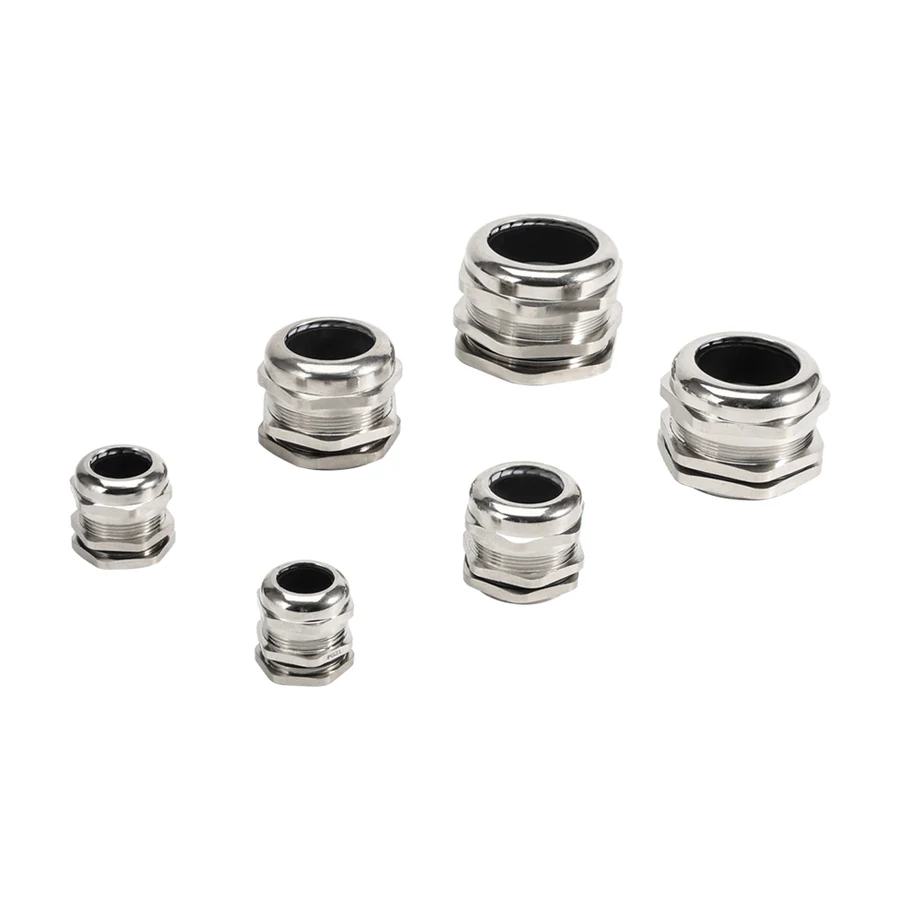
Nickel-plated brass glands in PG sizes: the body sets the mechanical and chemical margin, while the NBR or EPDM seal sets the temperature limit.
Check cable range, thread, panel seal, and thread length
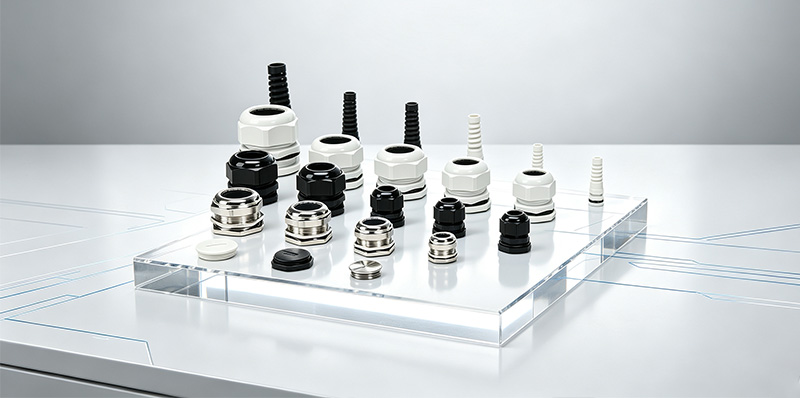
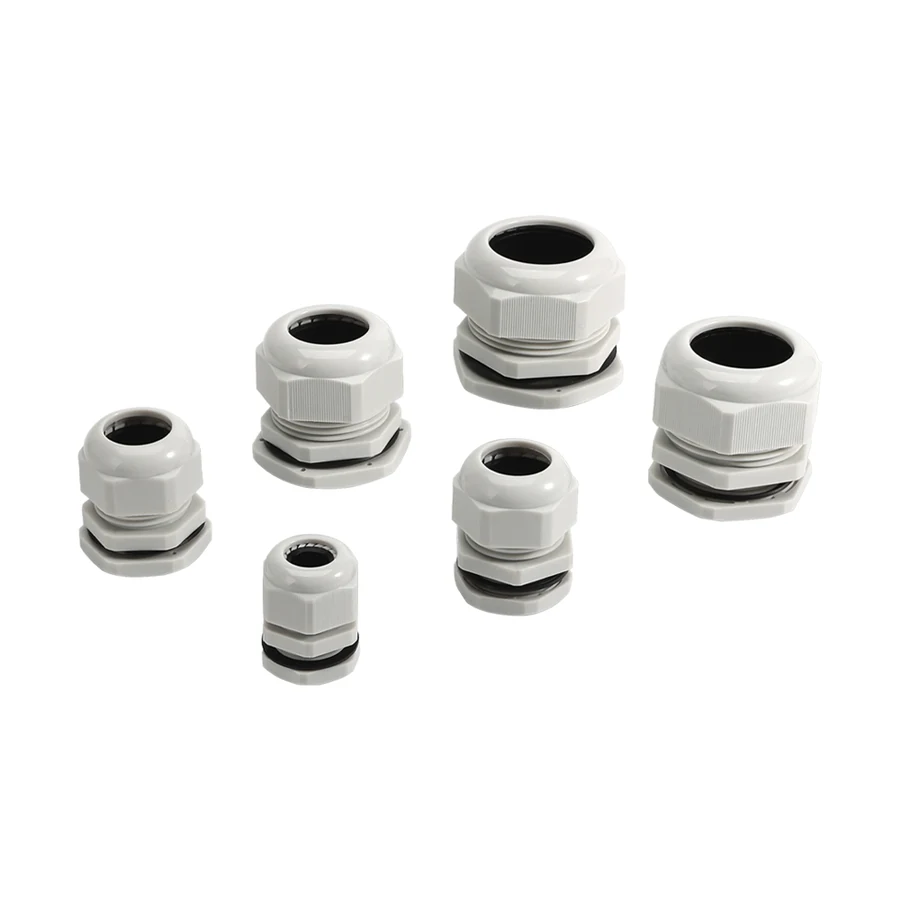
Cable range is the most common cause of a failed IP68 claim, and it fails in both directions. A cable below the minimum range cannot be compressed enough to seal; a cable above the maximum cannot enter without distorting the insert. Both produce a gland that looks installed and leaks. Published ranges run from 3–6.5 mm on a PG7 to 25–32 mm on a PG36, and the nylon waterproof cable gland range covers those sizes with a light-grey or black body.
Thread standard is the second check. Metric, PG, NPT and G threads are not interchangeable, and a PG gland forced into a metric hole will seal on the thread compound rather than on the designed interface. Thread length is the third and the most overlooked: the same gland body is offered in standard and long-thread versions, and the difference decides whether a locknut can be fitted on a thick wall. On a PG7, the standard brass body carries roughly 6 mm of thread while the long-thread version carries around 15 mm — enough for a 3 mm enclosure wall plus a sealing washer and a locknut.
Panel sealing is the fourth. A flat washer seals against a machined, flat surface. A moulded O-ring seals against a rougher surface and tolerates more torque variation. On a powder-coated enclosure, the coating thickness varies across the wall, and a flat washer that seals on one unit may leak on the next. If the enclosure is coated, specify a sealing washer rated for that interface rather than relying on the coating to be flat.
Not sure which gland suits the enclosure wall?
Send the cable OD range, wall thickness and thread type. WESTLEC engineers will confirm the model, thread length and seal compound before the order.
Interpret IP68 alongside jet and immersion requirements
IP68 is the only IP rating whose second digit is defined by agreement rather than by a fixed test. That single fact explains most of the confusion in procurement: two glands can both be IP68 while one is rated for 1 m for 30 minutes and the other for 10 m continuously.
Request the exact immersion test conditions for each model
Ask for three numbers per model: depth, duration, and whether the test was performed with the cable fitted. A gland tested without a cable proves the body and the panel interface, not the cable seal. A gland tested with a cable at the middle of its range proves the seal for that cable size only.
The difference matters most in flood-prone installations: pits, sumps, underground vaults and coastal cabinets. In those locations the specification should quote a depth and a duration, not a code. If the datasheet says “IP68” and nothing else, the correct response is a request for the test report, and the correct interim assumption is that the gland is rated no deeper than IP67 — 30 minutes between 0.15 m and 1 m.
Confirm separate jet ratings when both hosing and immersion occur
Washdown and flooding are different tests, and a gland can pass one and fail the other. IP66 is a jet test: a 12.5 mm nozzle at 100 kPa delivering about 12.5 litres per minute for at least three minutes. IP67 and IP68 are immersion tests with no jet component. A food-processing cabinet that is hosed down daily and also stands in a wet floor needs IP66 plus IP67/68, or IP69K where high-pressure, high-temperature washdown is specified.
IP69K is defined in ISO 20653, not in IEC 60529, and it is not a higher version of IP68. It describes resistance to a high-pressure, high-temperature jet at close range. A gland can be IP69K and not immersion-rated, which is exactly the wrong choice for a pit. Read the two ratings as separate capabilities and require both where both conditions exist.
For installation practice — torque, seal seating and the order in which the parts are assembled — our IP68 cable gland installation guide covers the sequence in detail. The point here is simpler: a correctly rated gland installed with the wrong torque or without the panel seal is a standard gland with a better label.
Choose by exposure and verify the enclosure as a system
Protection is a property of the enclosure, not of the gland. A single IP68 gland in an IP54 box produces an IP54 box. That is not a reason to stop specifying good glands; it is a reason to specify them by exposure and then check the rest of the enclosure.
Assess dry indoor service, outdoor rain, flooding, and washdown separately
Four exposures, four different requirements. Dry indoor panels need a gland that holds cable retention and stops dust; IP54 to IP65 is usually sufficient and an IP68 gland adds cost without adding value. Outdoor rain needs UV-stabilised material, a sealing washer, and a drip loop so water runs off the cable rather than into the gland. Flooding needs a stated depth and duration plus a cable seal that was tested with the cable fitted. Washdown needs a jet rating, corrosion-resistant hardware, and a thread that does not trap water.
The selection table below is the working summary:
| Exposure | Minimum useful rating | What to specify beyond the code |
|---|---|---|
| Dry indoor panel | IP54–IP65 | Cable range, retention, thread type |
| Outdoor, rain only | IP65–IP66 | UV-stabilised body, sealing washer, drip loop |
| Occasional standing water | IP67 | Stated depth and duration, cable fitted during test |
| Continuous immersion | IP68 | Depth, duration, seal compound, long thread |
| High-pressure washdown | IP66 or IP69K | ISO 20653 rating, brass or stainless hardware |
Account for other openings and moisture travelling inside the cable
Every enclosure has more than one opening. A single IP68 gland on a box with an unsealed pushbutton, a cable entry without a gland, or a corroded gasket is a sealed hole in an unsealed enclosure. The verification step is a pressure or hose test on the assembled box, not a datasheet review.
The second path is inside the cable. A stranded conductor wicks water along its length, so a sealed gland on the outside can still deliver moisture to a terminal block on the inside. The countermeasures are a cable with a blocked core, a drip loop before the gland, or a sealing compound at the sheath end. In outdoor installations, this path accounts for a meaningful share of “the gland failed” reports where the gland did nothing wrong.
The third path is condensation, and it is the one a waterproof cable supplier cannot solve with a better seal. A perfectly sealed enclosure with a temperature cycle produces internal condensation, and the water arrives without any leak at all. Pressure-equalisation elements address that, and they are cheap compared with replacing a controller.
Specifying glands for an outdoor or buried installation?
Tell us the exposure, cable OD and wall thickness. We will match the thread length, seal compound and stated immersion conditions to the duty.
Frequently Asked Questions
How does an IP68 waterproof cable gland differ from a standard gland?
Mainly in sealing margin and construction: a longer sealing path along the sheath, a more substantial panel interface, and a thread length that suits thicker walls. A standard gland can also be IP68 rated, but it usually achieves the rating with less margin at the edges of its cable range.
Can a standard compression cable gland also be IP68 rated?
Yes. IP68 is a test result, and nothing in IEC 60529 requires a particular construction. The question to ask is not whether it is rated, but with which cable range, thread length and test conditions the rating was achieved.
Does IP68 automatically include IP66 jet protection?
No. IP66 is a jet test and IP68 is an immersion test, and they are independent. A gland rated IP68 without a jet rating may fail under hose-down even though it survives immersion.
What depth and duration does an IP68 cable gland cover?
Whatever the manufacturer states, because the standard leaves it to agreement between manufacturer and user. If no depth and duration are published, treat the gland as no better than IP67 until a test report is provided.
Does fitting an IP68 gland make the whole enclosure IP68?
No. The enclosure rating is set by its weakest opening, including gaskets, pushbuttons, vents and unused entries. One IP68 gland in an IP54 box gives an IP54 box.
Does a metric or PG waterproof gland need thread sealant?
Not if the panel seal and the thread interface are correct. Sealant is sometimes used on damaged or mismatched threads, which treats the symptom. Where a thread must be sealed, use a compound compatible with the body material and the seal elastomer.
Which seal material should I choose, NBR or EPDM?
NBR for oil-bearing atmospheres and general industrial duty; EPDM for weathering, ozone, steam and washdown. Both cover a similar temperature band, so the chemical environment usually decides.
Why do two glands with the same IP68 rating cost so differently?
Material, seal design, thread length and testing scope. A brass body with a machined seal seat and a long thread costs more than a short nylon body, and the difference buys margin at the edges of the cable range rather than a different code.
Conclusion
The difference between an IP68 waterproof cable gland and a standard gland is not the label, and it is not the material. It is the amount of sealing margin designed into the cable entry, and whether that margin was verified with a cable of your size at a stated depth and duration. Two glands can share a certificate and behave very differently in service.
The working check is four lines on the datasheet: cable range, thread length, seal compound, test conditions. Add the enclosure review, and the entry stops being the weak point of an otherwise good box.
About The Author
Written by the WESTLEC engineering team, Yueqing, Zhejiang, China. WESTLEC manufactures waterproof cable glands, DIN rail terminal blocks, crimp terminals and busbars for low-voltage assemblies under an ISO 9001 quality system, with IEC 62444 and UL documentation available on request.
Last reviewed: November 2026
Related Resources
● How to find reliable waterproof cable gland suppliers from China
● Benefits of partnering with OEM waterproof cable gland suppliers
● 7 benefits of using IP68 waterproof cable glands
● How to choose the right size for an IP68 waterproof cable gland
 EN
 PT
