

Ask a project buyer why the gland schedule has 34 line items for 11 cable sizes and the answer is usually “that is how the last project was done”. Ask the site team how many of those glands were installed with the wrong seal, and the answer is quieter. Standardization is not an aesthetic preference. It is the difference between a schedule that a storeman can pick correctly and one that requires an engineer, and it is the reason so many projects end up standardizing waterproof cable glands after the first difficult installation.
This article is about the cost case for standardizing IP68 waterproof cable glands, and it deliberately separates three things that are usually bundled together: the cost of the part, the cost of specifying it consistently, and the cost of the IP68 rating itself. Only the first appears in a quotation.
Why Standardized IP68 Waterproof Cable Glands Lower Project Cost
A gland family is a small catalogue with a fixed number of models, one seal system, one material set and one thread standard, chosen to cover the cable schedule with the fewest part numbers. The saving does not come from buying a cheaper gland. It comes from buying fewer kinds, installing them correctly the first time, and not carrying the rest for a decade.
Separate savings from specification consistency from the IP68 rating itself
Three different savings are often claimed under one heading, and they behave differently.
Specification consistency is the first. Every additional part number adds a decision at the store, a line on the drawing, a risk of substitution and a stock item. Reducing 34 line items to 12 does not change the cable schedule; it changes how many ways the schedule can be misread.
Installation consistency is the second. A family with one seal design and one tightening method produces a repeatable installation. A mixed schedule produces a mix of techniques, and the ones that leak are usually the ones installed by whoever had not seen that model before.
Rating discipline is the third, and it is the one that gets confused with the other two. Specifying IP68 cable glands everywhere is not standardization; it is over-specification with a consistent label. The saving comes from specifying the right rating per exposure and standardizing within each exposure band — IP65 for the dry indoor cabinet, IP68 for the pit, IP66 or IP69K for the washdown area.
Map cost drivers across purchasing, installation, and maintenance
The cost of a cable entry is spread across four phases, and the part price is the smallest of them in most projects.
| Cost driver | Where it appears | How standardization acts on it |
|---|---|---|
| Part cost | Purchase order | Higher volume per model, fewer small-quantity lines |
| Installation labour | Site hours | One technique, one torque, fewer errors and re-visits |
| Rework | Snag list, water ingress claims | Correct cable range and seal for each band |
| Downtime | Maintenance, production loss | Spares on the shelf for every model actually used |
| Inventory | Stores, working capital | Fewer SKUs, higher turns, less obsolescence |
| Procurement admin | RFQs, approvals, incoming inspection | One approved family instead of per-project sourcing |
Use the table as a checklist, not as a set of percentages. The actual split has to come from the project’s own records: install hours per gland, the snag list from the last project, and the stock value of the parts that were never used.
How many gland SKUs does your schedule really need?
Send the cable schedule with outside diameters. We will map it to a reduced gland family and show where a single model can cover two adjacent sizes.
Create an approved gland family around the actual cable schedule
The family is built from the cable list, not from the catalogue. The sequence is: extract every cable outside diameter, group the diameters into bands, choose one gland per band, then confirm the thread and the seal material for the environment.
Map PG, metric, G, and NPT options to the cable schedule
Thread standard is decided by the enclosure, not by the gland. A European enclosure usually has metric or PG holes; a North American enclosure may use NPT; a legacy panel may use G (BSPP). Standardizing on one thread standard across a project is only possible if the enclosures are specified at the same time.
Cable range is decided by the schedule. Published ranges overlap deliberately, which is what makes SKU reduction possible, and the mapping from cable outside diameter to thread size is set out in how to choose the right size for an IP68 waterproof cable gland:
| Thread size | Cable range (mm) | Typical use in a panel |
|---|---|---|
| PG7 | 3–6.5 | Sensors, signal wiring |
| PG9 | 4–8 | Signal and low-power control |
| PG11 | 5–10 | Control multicore, small power |
| PG13.5 | 6–12 | Control cables with thicker jackets |
| PG16 | 10–14 | Motor supply, armoured entry |
| PG21 | 13–18 | Power feeds, larger multicore |
| PG29 | 18–25 | Main feeds, generator cables |
| PG36 | 25–32 | Heavy power, incoming supply |
The reduction usually comes from the middle of the table. Three cable sizes between 6 mm and 12 mm can often be covered by one PG13.5 gland, and two between 10 mm and 14 mm by one PG16. What cannot be merged is the extremes: a 3 mm sensor cable and a 25 mm power cable need different bodies, and forcing them into one “standard” gland is how a seal gets over-compressed at one end and under-compressed at the other.
Standardize seals, accessories, materials, and stated immersion conditions
Seal material is the second axis of standardization, and it applies to the nylon waterproof cable gland and the metal equivalent alike. NBR covers roughly −30 to +100 °C and handles oils; EPDM covers roughly −40 to +120 °C and handles weathering, ozone and steam. Choosing one compound per project band avoids the situation where two visually identical glands behave differently in the same washdown area.
Accessories are the third. A gland without its locknut and sealing washer is not installed, and a project that standardizes the gland but not the kit will still order three accessory lines. Standardize the kit: body, seal, washer, locknut, and the torque value, in one part number.
Immersion conditions are the fourth, and the one that most often breaks a standard family. IP68 is defined by agreement between manufacturer and user, so a family built for 1 m for 30 minutes cannot be substituted for a specification that requires 5 m continuous. Standardize within a stated depth and duration, and treat anything deeper as an exception with its own part number.
Reduce repeatable costs on site and in stores
The savings that survive audit are the ones that repeat: every installation, every replenishment, every fault. That is why the RFQ and the stores list matter more than the unit price negotiation.
Specify complete kits and installation requirements in the RFQ
An RFQ that asks for “IP68 glands, quantity as schedule” will produce a quotation that is impossible to compare, because each supplier will assume a different accessory set. Specify the kit contents, the thread standard, the cable range, the seal material, the required documentation and the packing format.
Three lines in the RFQ do most of the work. First, “gland, seal, sealing washer and locknut supplied as one kit, one part number”. Second, “cable range tested with cable fitted, stated depth and duration”. Third, “installation torque and strip length stated in the packaging or the datasheet”. Those three lines convert a price comparison into a specification comparison.
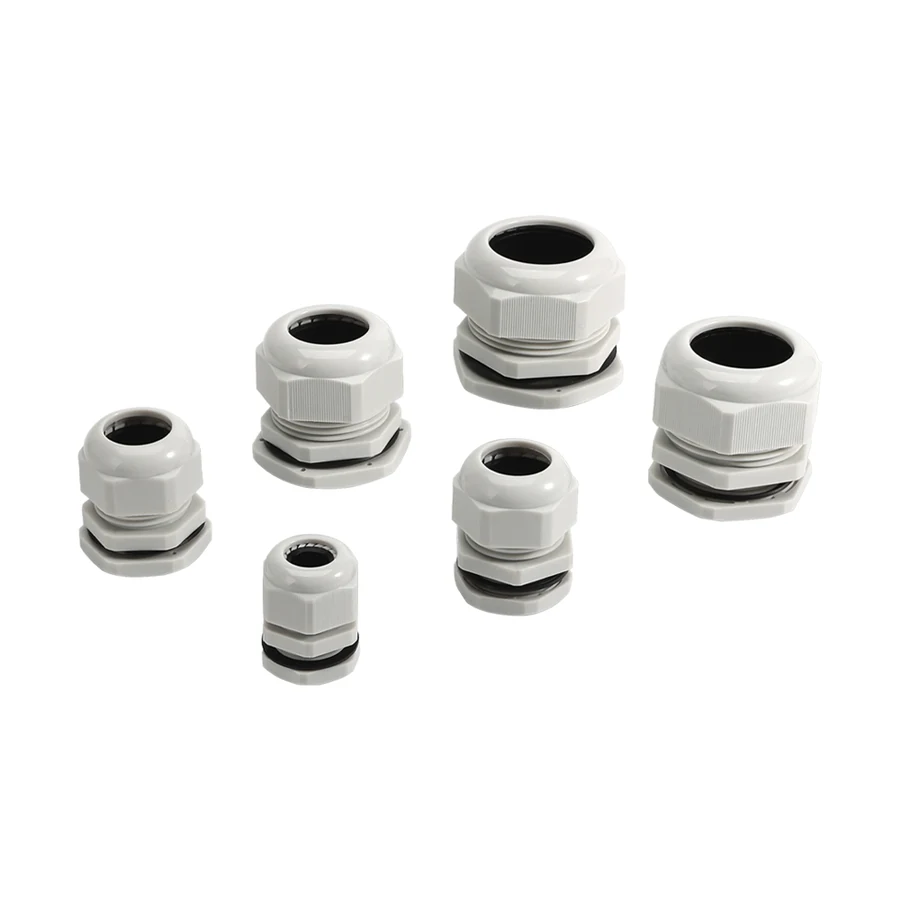
A gland family in PG sizes: one body design, one seal system and one kit definition per cable band is what makes a reduced schedule workable on site.
Installation requirements belong in the same document. A gland installed with the wrong torque leaks regardless of its rating, and a site team that has to look up a different torque for every model will get some of them wrong. One family, one torque, one instruction sheet — the same logic that OEM waterproof cable gland supply relies on.
Simplify replenishment, spares, and approved substitution decisions
Spares are where a 34-line schedule becomes a 20-year cost. Every model that appears once on the drawing still needs a spare on the shelf if a cable is damaged, and the spare has to be the right one. A family of 12 models with clear cable bands allows a storeman to pick a substitute within the band without an engineering decision.
Approved substitution is the formal version of the same idea. Define, per band, which model may replace which, and under what conditions — same thread, same or wider cable range, same or better seal material, same or better stated immersion. That table is what prevents a site emergency from becoming an unapproved change.
Replenishment follows. Fewer part numbers mean larger order lines, fewer minimum-order penalties, and a simpler reorder point. It also changes how you assess waterproof cable gland suppliers: a supplier who can hold a family is more useful than one who quotes a single model. The saving is administrative, which makes it easy to overlook and easy to measure: count the purchase orders and the stock lines before and after.
Prove the business case without over-specifying protection
A standardization proposal will be challenged on two grounds: that it costs more per unit, and that it reduces flexibility. Both are answerable with project records rather than assertions.
Compare part cost, labour, rework, and downtime using project records
Build the comparison from four numbers that already exist. Installed cost per gland is the part price plus the install hours multiplied by the site rate, plus the accessory lines. Rework cost is the number of water-ingress or fitment snags on the last project multiplied by the average rework hours. Downtime cost is the production loss per event multiplied by the event frequency. Inventory cost is the value of gland stock multiplied by the carrying rate.
Present the four together. A standardized family usually loses on the first number and wins on the other three, and the only honest way to show that is with the project’s own data. Where the data does not exist, say so and propose a measured pilot on one enclosure rather than an estimated saving on the whole project.
Keep exceptions for washdown, hazardous areas, or unusual cable types
Standardization fails when it becomes dogma. Four exceptions are legitimate and should be written into the standard rather than handled as deviations.
Washdown areas need a jet rating and corrosion-resistant hardware, which may mean a brass waterproof cable gland or a stainless body rather than the standard nylon one. Hazardous areas need Ex-rated glands certified as part of an assembly, not a standard gland with a certificate. Unusual cables — flat cables, very large diameters, cables with a non-circular section — fall outside the band system. And high-temperature zones need a seal compound and a body that the standard family may not offer.
The rule is that an exception must name its condition, its part number and its approval route. A standard family with four documented exceptions is stronger than a bespoke schedule with thirty-four.
Building a gland standard for a multi-site project?
We can supply the family, the cable-band matrix and the kit part numbers in one document, so procurement and site work from the same list.
Frequently Asked Questions
How do standardized cable glands reduce project cost?
By reducing the number of part numbers, which lowers installation errors, rework, stock value and procurement admin. The unit price may be similar or slightly higher; the saving appears in labour, snags and inventory rather than in the purchase order.
Is specifying IP68 on every entry the cheapest way to standardize?
No. It standardizes the label and over-specifies most entries. Standardize within exposure bands — IP65 indoors, IP66 for rain, IP68 for immersion — and keep the family consistent inside each band.
Why can two glands both marked IP68 still cause project delays?
Because IP68 is defined by agreement, so the depth, duration and test cable differ. A substitute that meets the code but not the stated conditions has to be rejected on site, which stops the installation until someone approves an alternative.
Are locknuts, sealing washers, or other accessories still needed in the kit?
Yes. The gland seals the cable; the washer and locknut seal and secure the panel interface. Standardize the kit as one part number so the accessories cannot be ordered separately or omitted.
Can a generic or uncertified gland undermine a standardized specification?
Yes, and it usually does so quietly. A generic gland with a different seal geometry breaks the single-torque, single-technique assumption that made the standard work, and the failure appears as an isolated leak rather than a systemic one.
How do I size a standard gland family to cover most cables with fewer SKUs?
Group cable outside diameters into the published ranges, merge adjacent sizes where the overlap allows, and keep separate models only at the extremes and for special duties. A family of 10 to 12 models usually covers a typical panel schedule.
Does standardization reduce the ability to respond to a design change?
No, provided the family has documented exceptions and an approved substitution table. A design change inside a cable band is handled by substituting within the band; only a change outside the bands needs a new part number.
How should the savings be presented to a project board?
As four measured lines — installed cost, rework, downtime and inventory — taken from project records, with the assumptions stated. A single percentage claim without the underlying counts will not survive a review.
Conclusion
Standardizing IP68 cable glands is a specification exercise with a cost outcome, not a purchasing trick. The saving comes from fewer decisions: fewer part numbers to pick, one installation technique to learn, one seal material per band, one torque to record, and a spare that a storeman can find.
Build the family from the cable schedule, keep the IP rating tied to the exposure rather than the catalogue, and prove the case with four measured lines. That is a standard a project board can approve and a site team can actually follow.
About The Author
Written by the WESTLEC engineering team, Yueqing, Zhejiang, China. WESTLEC manufactures waterproof cable glands, DIN rail terminal blocks, crimp terminals and busbars for low-voltage assemblies under an ISO 9001 quality system, with IEC 62444 and UL documentation available on request.
Last reviewed: November 2026
Related Resources
● IP65 vs IP66 vs IP67 vs IP68 waterproof cable gland connector
● 7 benefits of using IP68 waterproof cable glands
 EN
 PT